
Search behavior has changed. Search intent hasn’t.
Whether you like it or not, LLMs, voice search, and AI overviews have rapidly changed the way we think about search. Keywords are still important, but people rarely type short, clipped phrases into their search bars anymore.
Seeking answers by typing things like “best travel backpacks” or “cheap coffee makers” may have worked well in the past, but the people who really know how to find what they’re looking for ask questions or prompt conversationally.
The users I just mentioned? They look for context with extended queries, like “What’s a great backpack for a trip to Yosemite?” or “Which coffee maker costs less than $100 with a good warranty?”
The bigger question about these questions is what you’re going to do about it.
Conversational search goes much deeper than you might realize. Optimizing your content for question-based search is now an essential part of SEO. Don’t think of it as a trend, but as a tactic to ensure visibility across every platform that users engage with.
What You Need to Know Right Now
- Users today tend to search in complete thoughts and questions instead of clipped, keyword-focused phrases.
- LLMs and voice search have changed the game by focusing on answering questions.
- Content that satisfies these queries often focuses on the context a user provides, like unique business needs or other details.
- The best way to see quick SEO wins is to refresh content to answer these question-based queries.
How User Search Behavior Has Evolved Beyond Keywords
The transformation from short, fragmented keyword searches (like “best CRM software”) to full conversational queries (“What’s the best CRM software for a small marketing agency?”) has been in the works for years now, especially as tools like Siri, Alexa, and Google Assistant – now Gemini – have become household staples.
Unless you’re particularly stubborn, you’re probably not shouting short phrases into your phone. We’ve seen the commercials for ChatGPT, Gemini, and other tools that illustrate this in the real world.
This isn’t a Trend
AI Overviews and voice search tools have changed what “search” means, and there’s likely no going back.
The best way to deal with this development is to take the steps to build great content that focuses on answering these types of questions. That means knowing what your users are asking (via long-tail keywords) just as much as why they’re asking it (understanding their search intent).
Why LLMs and Voice Search Demand Answer-Ready Content
Think of it this way: Search engines used to act like librarians. You gave them a short phrase, and they pointed you toward a shelf. Sometimes they knew a specific answer (featured snippets).
AI-driven search is different. It’s more of a research assistant. It takes the query and interprets intent before trying to produce the most useful response possible.
LLMs don’t rank pages in the traditional sense. They extract information from content that’s easy to interpret and clearly structured. That’s why it has to be written in a way that actually reflects how people ask questions.
This is the context of answer-ready content. Pages that explicitly respond to questions are easier for AI systems to understand and summarize. Keyword repetition without clarity usually gets overlooked.
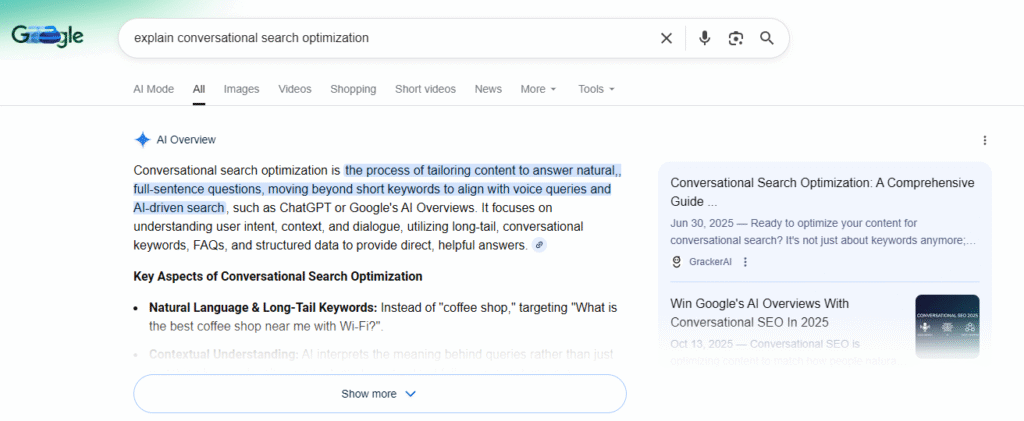
Think about Google’s SERP in particular. Featured snippets and other position zero placements play a bigger role in this environment. In fact, they’re often the source material for AI overviews. Google has been clear that these features focus on directly delivering answers, especially when users have question-based searches.

Voice search adds another layer. If you ask a question out loud, there’s no results page to browse. You get one answer, and everything else is invisible. Content that isn’t structured to provide a clear response likely won’t be chosen as a result.
This also helps explain why Google alternatives have gained traction. Tools like ChatGPT and Perplexity reward clarity over traditional ranking signals. It’s a shift with real implications for how you should write and organize your content.
Fast Facts About Voice Search
- Recent data shows that 20.5% of people globally use voice search.
- Among those users, 36% use Siri, 36% use Google Assistant, and 25% use Alexa.
- The average voice search result has a length of 29 words.
Breaking Down the Tech that Prioritizes Semantic Keyword Optimization
The trick is that semantic systems don’t look for exact matches. AI seach optimization must also be focused on meaning.
LLMs connect topics, concepts, and relationships. A query about “best CRM for agencies” might return a response that includes price concerns, integrations, scalability, and onboarding. Even if those words aren’t used, the semantic search will bring those considerations as part of its justification, especially if the resources it cites touch on those details.
Building a Query-Focused SEO Strategy Without Abandoning Keywords
What about those keywords, though?
A common misconception might be that question-based optimization or optimizing for natural language searches replaces keyword research. In practice, it just builds on top of it.
Keywords still define relevance. You’ll still need to factor them into your work. Conversational search optimization simply understands that questions determine usefulness. A strong query-focused SEO strategy starts with traditional keyword research and layers intent-driven questions over it. Here’s what that looks like:
1. Start With Your Core Keywords
Identify the primary terms that matter to your business. These still anchor your content and help search engines understand topical focus.
2. Identify the Questions Behind Those Keywords
Look beyond the keywords themselves. Check out the “People Also Ask” section of the SERP, Search Console queries, internal site search, and customer conversations. These reveal what your users actually want to know when they search those terms.

3. Map Questions to the User Journey
Each question usually has relevance to a specific stage of a customer’s journey. Some questions signal early research, while others can indicate comparison or a readiness to act (read: convert). Align answers to those stages of the funnel. It improves visibility and potential for conversions.
4. Structure Content So Answers are Easy to Find
Question-based headers, concise responses, and supporting context greatly help users and search systems. This is where the answer-ready content sings.
5. Use FAQ Schema Where Appropriate
Schema markup helps search engines understand what your page is answering. It can improve eligibility for enhanced results.
This is where an experienced SEO strategy team shows up. They’ll do the legwork to understand the business, challenges, customer concerns, and when something is a trend versus a lasting shift in search behavior.
Refresh Older Content with Question-Based Optimization
Most websites don’t actually need more content. They just need better-performing content.
Older pages can lose traction because search behavior changes around them. The topic can be relevant, but the way people search for it has evolved. Maybe statistics have changed, or the reporting on an issue or concept looks much different from when the piece originally went live. Perhaps competitors have outpaced you when it comes to relevance or features, and your website has struggled to keep up.
A content audit can help identify which assets are slipping before they impact conversions too much. Pages with declining traffic, weaker engagement, or outdated structures are strong candidates for updates.
Common improvements that can help with performance include:
- Adding strategic FAQ sections
- Rewriting headers as questions
- Tightening answers so they’re easier to extract or understand
- Strengthening internal links to related question-focused content that helps reinforce topical relevance.
This maintenance – known as content decay management – is a great way to prioritize efficiency in your content marketing strategy. It provides a clear framework for identifying which efforts will have the most impact.
Optimizing for Questions Across Multiple Platforms and Search Engines
Search engines aren’t the only ecosystem for finding answers. When you structure your content around real questions, it’s easier for everything – traditional engines, LLMs, voice-driven assistants, and more – to reuse, summarize, and surface. That supports visibility wherever your users search, not just traditional rankings.

More than that, it strengthens your local SEO efforts beyond mere Google Business Profile optimization. People often ask situational, location-based questions. Content that answers them is far more likely to appear across local results.
This is one of the biggest advantages of a question-based content strategy for businesses of all sizes. You can scale across multiple platforms without writing for specific ones.
Measuring Success: Tracking Performance of Question-Optimized Content
The changes in tactics also mean that success looks a little different in a conversational search landscape. That’s why we have to adjust how we measure SEO performance.
Traditional rankings still matter, but they’re only part of the picture. The previous wins – featured snippet placement, long-tail query impressions, and AI overview visibility – are additional signals.
Engagement metrics are more meaningful. Time on page, scroll depth, and conversion behavior often improve when content clearly answers questions early on.
You probably won’t be able to directly track voice and AI visibility, but that’s okay. There are some tools out there (and we use them), but because all of this is so new, we have to be honest when we explain that we don’t have historical precedence to compare data to.
No matter what, the goal is to look for directional improvement and compound gains over time. Question-focused optimization is a long-term layer that complements your existing SEO metrics.
Start Optimizing for Questions Today
The biggest thing to remember is that the shift we’re seeing doesn’t force a choice between keywords and questions. Instead, you need to recognize how search works and make appropriate adjustments.
The best place to start? A content audit. You’ll reveal quick wins and highlight where question-based optimization can make an immediate difference.
Teams that adopt query-focused strategies earlier tend to see stronger compounding results. The ones who wait often end up reacting instead of leading.
Where does that leave you?
If you’re looking for a partner to help guide the transition, our SEO services support the modern, intent-driven strategies built for how users actually search today. We focus on a holistic approach that marries technical search engine optimization excellence with content that speaks directly to your audience and answers their questions.
FAQ's
Keyword optimization focuses on matching search terms. Question-based SEO focuses on answering the intent behind those terms, making content more useful across traditional and AI-driven search experiences.
No. Many improvements come from updating the structure, adding FAQs, and rewriting headers to reflect real questions without rebuilding pages from scratch.
Search Console data, “People Also Ask,” internal search queries, sales calls, and customer support conversations reveal the questions users are already asking.
When done correctly, optimizing for questions helps traditional keyword rankings. Clear answers improve relevance and engagement, which can strengthen keyword performance.
Some gains appear quickly through featured snippets. Broader impact typically builds over several months as content earns trust across platforms.