Finding the right marketing agency feels a lot like hiring a key employee, except you’re evaluating an entire team you’ve never worked with based on a few conversations and a polished proposal. The stakes are real: pick well, and you get a partner who accelerates growth; pick poorly, and you’ve burned budget and months of momentum.
Here, we walk you through what agencies actually do, how to tell which type fits your situation, what to look for during evaluation, and the questions that separate strong partners from slick salespeople.
Table of Contents
What a Marketing Agency Actually Does
Choosing the right marketing agency starts with defining your business goals, setting a clear budget, and finding a partner with a proven track record in your industry. A marketing agency handles the planning, execution, and measurement that most businesses can’t manage internally with the same depth or consistency.
Unlike hiring a single marketing employee who specializes in one area, an agency brings together people across multiple disciplines: SEO strategists, content writers, paid media buyers, public relations specialists, designers, and analysts working as a coordinated team. The agency model also offers flexibility. You can scale services up or down based on what your business actually needs rather than being locked into a fixed headcount.
Signs It's Time to Hire a Marketing Agency
Most businesses don’t wake up one day and decide they need an agency. Usually, something specific triggers the search. Recognizing the trigger helps clarify what kind of support you’re really looking for.
- Your internal team is stretched thin: Marketing tasks keep sliding to the bottom of the priority list because everyone has other responsibilities.
- Growth has plateaued: Traffic, leads, or revenue have stalled and you’re not sure what’s causing it.
- You lack specialized expertise: You need SEO, paid media, public relations or content skills your current team doesn’t have.
- You’re launching something new: A new product, location, or market requires focused marketing support.
- You’re spending on marketing but can’t measure results: Money goes out, but there’s no clear reporting on what’s working.
In-House Team, Freelancer, or Marketing Agency
Before evaluating specific agencies, it helps to understand whether an agency is even the right choice. Each option has trade-offs.
| Option | Best For | Limitations |
|---|---|---|
| In-house team | Businesses with consistent, high-volume needs and budget for salaries plus tools | Expensive to build Limited skill range |
| Freelancer | Specific, project-based tasks like copywriting or design | Hard to scale May lack strategic oversight |
| Marketing agency | Businesses needing multiple disciplines, strategic guidance, and flexible capacity | Requires clear communication Takes time to onboard |
An agency often makes sense when you need both strategy and execution across several marketing channels but don’t have the budget or volume to justify building a full internal team.
Types of Marketing Agencies to Know
Not all agencies do the same work. Understanding the different types helps narrow your search before you start evaluating individual firms.
Full-service digital marketing agency
Full-service agencies handle multiple marketing disciplines under one roof, including SEO, paid media, content, digital public relations, social, and analytics. The main benefit is coordination across channels without managing multiple vendor relationships.
SEO agency
SEO agencies specialize in organic search visibility through technical optimization, content strategy, and link building (digital public relations). They’re a good fit if your primary goal is long-term organic traffic growth.
Performance and paid media agency
Performance agencies focus on paid advertising across Google, Meta, LinkedIn, and other platforms. Their strength is campaign management, budget optimization, and conversion tracking.
Content marketing agency
Content agencies create blog posts, videos, guides, and other assets. Content supports SEO, link building, thought leadership, and lead nurturing, though some content agencies focus more on production than strategy.
Understanding how content marketing and SEO work together can help you evaluate an agency’s approach to strategy and production.
Social media agency
Social agencies manage your presence, community engagement, and social advertising. Some focus primarily on organic posting while others specialize in paid social campaigns.
Growth marketing agency
Growth agencies combine strategy with rapid testing and iteration. They typically work across the full funnel from acquisition to retention, prioritizing speed and measurable outcomes.
Core Services a Full-Service Marketing Agency Offers
If you’re considering a full-service agency, here’s what a comprehensive offering typically includes.
SEO and AI search visibility
SEO now extends beyond traditional search engines to include optimization for AI-powered tools like Google’s AI Overviews. A capable agency handles technical SEO, on-page optimization, and link building while also considering how content appears in AI-generated responses.
Content strategy and production
Content strategy involves planning what to create, for whom, and why. Production means actually writing the blogs, guides, and videos. The best agencies connect content directly to business goals rather than just publishing for volume.
Paid media and performance marketing
Paid media includes Google Ads, social advertising, and retargeting campaigns. The agency’s job is managing your budget effectively and tracking conversions, so you know what’s actually driving results.
Email and lifecycle marketing
Email marketing remains one of the highest-ROI channels for nurturing leads and retaining customers. Look for agencies that handle automation, segmentation, and performance tracking rather than just sending newsletters.
Social media and digital PR
Organic social management builds community, while digital PR earns media coverage and backlinks that strengthen your site’s authority. The two disciplines often work together to increase brand visibility.
Ask which digital PR strategies the agency uses to earn relevant coverage and backlinks.
Analytics and transparent reporting
Reporting isn’t optional. A good agency provides clear dashboards and explains what the data means for your business decisions, not just what happened but what to do next.
What to Look for in a Marketing Agency
This is where the real evaluation begins. The following criteria help distinguish between agencies that look good on paper and those that will actually deliver.

Relevant industry experience
Agencies familiar with your industry or business model can ramp up faster. They already understand your audience, competitive dynamics, and common challenges. That said, exact industry match isn’t always required if they demonstrate transferable skills and a willingness to learn.
Strategic thinking paired with hands-on execution
Some agencies only strategize. Others only execute what you tell them. The best partners do both: they develop the plan and do the work.
Transparent reporting and clear communication
Good reporting means regular updates with understandable metrics tied to your business goals. It also means honest conversations about what’s not working. If an agency only shares good news, that’s a warning sign.
Proof of measurable results
Case studies and references matter, but learn how to evaluate them. Ask for examples relevant to your goals, whether that’s leads, revenue, or traffic, not just vanity metrics like impressions or followers.
Cultural fit and working style
The agency becomes an extension of your team. Consider communication preferences, responsiveness, and whether their values align with yours. A technically excellent agency that’s frustrating to work with rarely delivers great outcomes.
Flexible engagement structure
Agencies offer different models: monthly retainers, project-based work, or sprint-based delivery. A good agency offers structure that matches your needs and budget rather than forcing you into a one-size-fits-all contract.
Questions to Ask Before Hiring a Marketing Agency
The following questions help you get past the sales pitch and understand what working with an agency will actually look like.
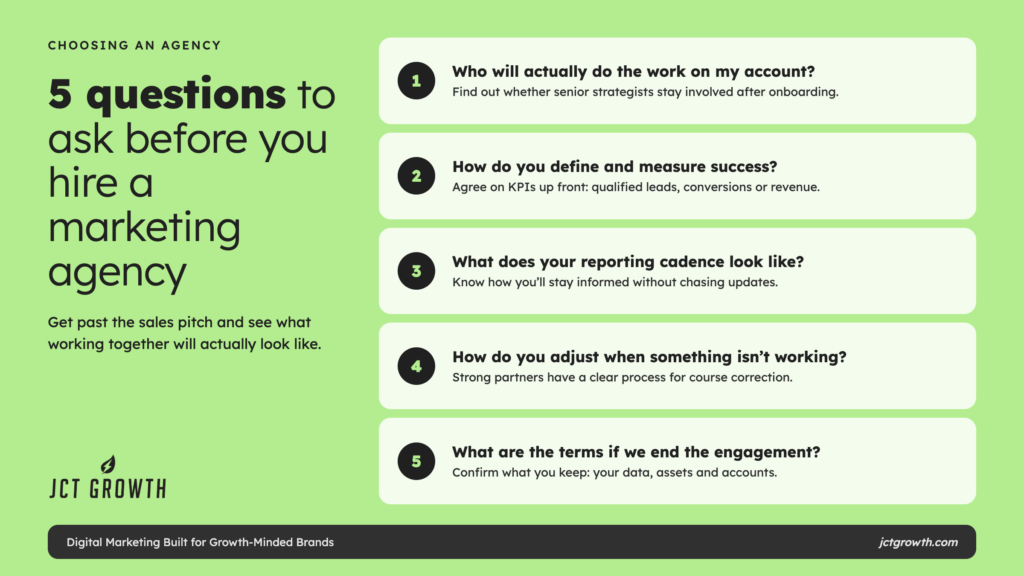
1. Who will actually do the work on my account
Sales teams don’t always reflect the people executing. Ask about the team structure and whether senior strategists stay involved after onboarding or hand you off to junior staff.
2. How do you define and measure success
Get alignment on KPIs upfront. The agency’s definition of success needs to match yours, whether that’s qualified leads, conversions, or revenue growth.
3. What does your reporting cadence look like
Weekly? Monthly? What’s included? You want to know how you’ll stay informed without constantly chasing updates.
4. How do you adjust strategy when something isn’t working
Marketing requires iteration. Ask how the agency handles underperforming campaigns and what their process looks like for course correction.
5. What are the terms if we want to end the engagement
Understand contract length, cancellation terms, and what you retain (data, assets, accounts) if you part ways.
How Much a Marketing Agency Costs
Agency costs vary widely based on scope, services, and experience level. Rather than focusing on a specific number, understand the common pricing models:
- Monthly retainer: Ongoing relationship with a set scope of work each month.
- Project-based: Fixed fee for a defined deliverable like a website redesign or content audit.
- Hourly: Pay for time spent, common for consulting or overflow support.
- Performance-based: Fees tied to results, though this model is less common and requires careful contract terms.
The cheapest option isn’t always the best value. Evaluate cost against expected outcomes and agency quality rather than just comparing price tags.
Red Flags to Watch for When Vetting a Marketing Agency
The following warning signs during the sales and evaluation process often predict problems after you sign.
Guaranteed rankings or overnight results
No agency can guarantee specific rankings or instant outcomes. Promises like “page one in 30 days” signal either inexperience or dishonesty.
Vague deliverables and missing timelines
If the proposal doesn’t clearly state what you’ll receive and when, expect confusion later. Good agencies define scope precisely.
Poor communication during the sales process
How they treat you before you sign is often how they’ll treat you after. Slow responses or unclear answers are warning signs worth taking seriously.
One-size-fits-all strategies
Cookie-cutter approaches ignore what makes your business unique. Look for agencies that ask questions and customize recommendations to your goals rather than pitching the same package to everyone.
How Long Before You See Results From a Marketing Agency
Timelines depend heavily on which services you’re using. Paid media typically shows faster feedback, often within weeks, though optimization continues over time. SEO and content usually take three to six months to produce meaningful organic traffic growth. Brand awareness takes even longer to measure, though engagement metrics provide early signals.
Sustainable growth takes time. Agencies promising instant results are usually overselling what’s realistically achievable.
Find a Marketing Partner That Fits Your Business
The right agency becomes a true partner invested in your success, not just a vendor executing tasks. Look for a team that combines strategic guidance with hands-on execution, provides transparent reporting, and focuses on outcomes that matter to your business: qualified leads, conversions, and sustainable growth.
Start growing your online presence today by contacting JCT Growth for tailored marketing solutions.
Frequently Asked Questions About Choosing a Marketing Agency
An agency can be a good fit when your marketing needs exceed your team’s time or expertise. Look for a partner whose services, pricing, and experience align with your goals and budget.
The contract should give the agency enough time to execute and evaluate the agreed strategy. Before signing, confirm the initial term, deliverables, review milestones, cancellation terms, and ownership of your accounts and content.
Cost depends on the services, scope of work, agency experience, and level of support you need. Compare proposals based on clear deliverables and expected business value. Ask whether advertising spend, software, or setup fees cost extra.