
Most SEO advice assumes you’re competing for the same keywords as everyone else. That approach works fine if you have the budget and timeline of a Fortune 500 company, but for most businesses, it’s a recipe for frustration.
Niche SEO flips the script by targeting specialized, high-intent keywords where you can actually win. This guide covers the strategies that work across industries, from building topical authority and earning relevant backlinks to measuring what actually matters for your business.
Key Takeaways
- Niche SEO targets specialized, high-intent keywords instead of broad, high-volume terms, so businesses can compete where they can actually win and attract visitors who are closer to a buying decision.
- The strategy works across industries when every page is anchored to specific search intent and organized into long-tail topic clusters that build authority around your niche.
- Content depth, relevant industry backlinks, and solid technical fundamentals signal the expertise Google and AI search tools reward, which makes niche content more likely to rank and be cited in AI Overviews.
- Common mistakes include drifting toward broad keywords, publishing unedited AI content, and neglecting site speed or mobile experience, all of which dilute authority and hurt conversions.
- Success should be measured by qualified leads and revenue tied back to organic search, not rankings or traffic alone.
Table of Contents
What niche SEO actually means for your business
Niche SEO focuses on high-intent, specialized content and context-driven authority rather than chasing high-volume keywords. Instead of competing for broad terms like “marketing agency” or “accounting software,” you’re targeting the specific phrases your ideal customers type when they’re close to making a decision.
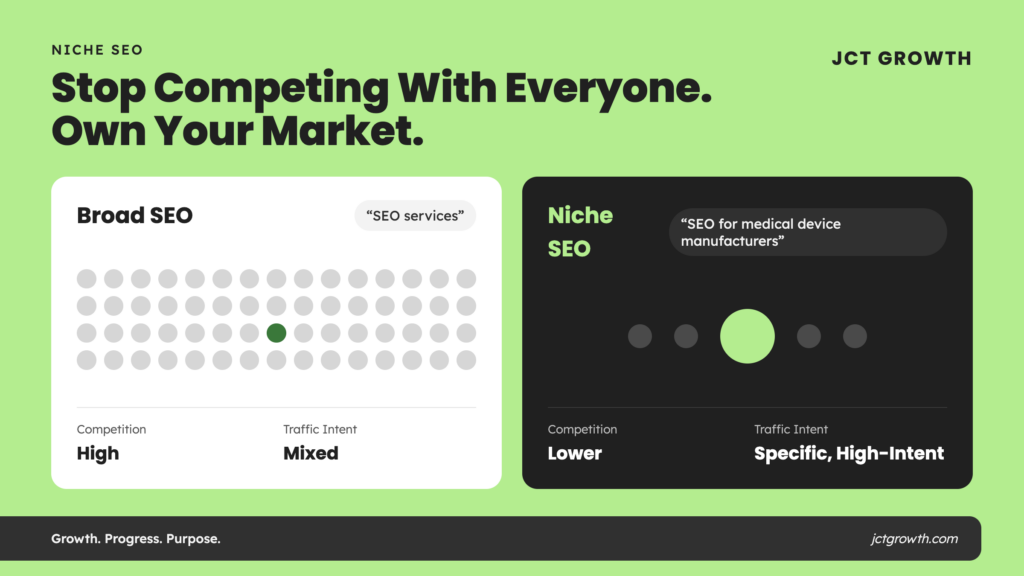
The difference comes down to focus. Broad SEO puts you in direct competition with industry giants who have years of content and thousands of backlinks. Niche SEO lets you become the definitive resource for a smaller, more specific audience.

| Approach | Example Keyword | Competition | Traffic Intent |
|---|---|---|---|
| Broad SEO | "SEO services" | High | Mixed |
| Niche SEO | "SEO for medical device manufacturers" | Lower | Specific, high-intent |
A healthcare SaaS company competing for “patient engagement software” faces dozens of well-funded competitors. But “patient engagement software for rural health clinics” attracts fewer searchers who are much closer to making a purchase.
Why niche SEO outperforms broad SEO in most industries
The math is straightforward. Fewer competitors means faster ranking potential. Higher intent means better conversion rates. And consistent coverage of a specialized topic builds the kind of authority that Google rewards.
There’s another advantage that often gets overlooked: you can actually win. A B2B company with a modest content budget can realistically become the top resource for their specific niche within a year. That same company trying to rank for generic industry terms might spend years without meaningful traction.
- Higher-intent traffic: Visitors searching niche terms have already narrowed their options
- Lower competition: Fewer businesses targeting the same specific keywords
- Faster ranking potential: New content can gain traction in weeks rather than months
- Stronger brand authority: Consistent niche content positions you as the go-to expert
Niche SEO strategies that work across every industry
The following tactics apply whether you’re running a B2B SaaS company, a local healthcare practice, an eCommerce brand, or a nonprofit. The specifics change, but the principles hold.
1. Anchor every page to specific search intent
Search intent describes what someone actually wants when they type a query. Are they looking for information, comparing options, or ready to buy? Matching your content to that intent is the foundation of niche SEO.
A page targeting “what is revenue cycle management” serves informational intent. A page targeting “revenue cycle management software pricing” serves commercial intent. Publishing the wrong content type for a keyword wastes effort and frustrates visitors who came looking for something else.
| Type of Search Intent | What Searchers Want* |
|---|---|
| Informational | To gain knowledge about a topic |
| Navigational | To find a specific website or page |
| Commercial | To research brands, products, or services |
| Transactional | To complete an action (e.g., make a purchase) |
| *As defined by Semrush |
2. Build a long-tail keyword map around your niche
Long-tail keywords are longer, more specific phrases with lower search volume but clearer intent. “Equipment rental” is a head term. “Construction equipment rental for residential contractors in Sacramento” is a long-tail keyword that attracts exactly the right visitor.
Start by listing the specific problems your customers face, the questions they ask during sales calls, and the language they use to describe their situation. Tools like Ahrefs, SEMrush, or Google’s autocomplete suggestions help you expand and validate your list.
Organize keywords into topic clusters rather than treating each one as a standalone target. A pillar page on “healthcare SEO” might connect to supporting pages on “SEO for dental practices,” “SEO for urgent care centers,” and “HIPAA-compliant content marketing.”
3. Publish deeper content than anyone else in your space
Niche audiences expect expertise. Surface-level overviews won’t cut it when your readers already understand the basics and want specific, actionable guidance.
Depth means addressing the particular questions, use cases, and pain points unique to your audience. It means including the details that only someone with real experience would know to mention. Google’s E-E-A-T framework (Experience, Expertise, Authoritativeness, Trustworthiness) rewards content that demonstrates genuine knowledge.
Look at what’s currently ranking for your target keywords. If the top results are 800-word overviews, a 2,000-word guide with original examples and practical steps can often outperform them.
4. Get technical SEO fundamentals right
Technical SEO isn’t unique to niche work, but it’s table stakes. A slow, poorly structured site undermines even the best content.
- Fast page load times on mobile and desktop
- Clean site architecture with logical URL structure
- Proper indexing and crawlability
- Schema markup relevant to your industry (LocalBusiness, Product, FAQ)
Technical elements support your content. They don’t replace it, but neglecting them creates unnecessary friction for both users and search engines.
5. Earn backlinks through digital PR and industry relationships
Niche businesses often struggle with link building because generic outreach doesn’t resonate. The solution is to focus on relevance over raw authority.
A single link from a respected industry publication or professional association carries more weight than dozens of generic directory links. Consider expanding DPR services so your business can start contributing to niche publications, participating in industry podcasts, or creating original research that others in your space will want to reference.
Services like Connectively (formerly HARO) connect businesses with journalists seeking expert sources. For niche industries, responding to relevant queries can generate high-quality backlinks while building your reputation.
6. Use local SEO where it applies
If your business serves specific geographic areas, local SEO tactics complement your niche work. Google Business Profile optimization, local citations, and review management help you appear in map results and location-based searches.
Local SEO applies to service-area businesses, healthcare practices, equipment rental companies, and any organization where customers care about proximity. A medical device company selling nationally might not prioritize local SEO, but a physical therapy practice absolutely would.
7. Optimize for AI overviews and conversational search
AI-powered search results pull from authoritative, well-structured content. Google’s AI Overviews and tools like ChatGPT increasingly cite sources that demonstrate clear expertise and provide direct answers to specific questions.
Structure your content for LLM readability with clear headings, concise definitions, and logical organization. Use lists and tables where they genuinely improve clarity. Include the kind of specific, expert-backed information that AI systems recognize as trustworthy.
Optimizing for AI search isn’t a separate discipline from traditional SEO. It’s an extension of the same principles: create genuinely helpful content that demonstrates real expertise.
8. Tie every SEO metric back to revenue
Rankings and traffic are intermediate metrics. What matters is whether organic search drives qualified leads, conversions, and revenue for your business.
Set up proper tracking and attribution from the start. Connect Google Analytics to your CRM. Track which pages generate form submissions and which keywords bring visitors who eventually become customers.
- Organic traffic by landing page: Which niche pages drive visits?
- Conversion rate from organic: How many visitors take action?
- Lead quality indicators: Are visitors the right prospects?
- Revenue attribution: Can you connect closed deals back to organic search?
Common niche SEO mistakes to stop making
Even focused work can fail when certain mistakes creep in.
Chasing high-volume keywords outside your niche
The temptation to go after broader keywords is real, especially when you see the search volume numbers. But diluting your focus wastes resources and often produces content that doesn’t convert. Stay in your lane until you’ve genuinely dominated your niche.
Publishing AI content without editorial review
AI-generated content without human expertise and editing lacks the depth and accuracy that niche audiences expect. Google’s helpful content guidelines specifically address low-quality AI content. Use AI as a drafting tool if you want, but the final product requires real expertise and editorial judgment.
Treating rankings as the only success metric
Ranking for a term that doesn’t drive qualified traffic or conversions is meaningless. A page ranking #3 for a high-intent niche keyword often outperforms a page ranking #1 for a vague, informational term.
Ignoring site speed and mobile experience
Technical neglect undermines even the best content. Many niche businesses focus exclusively on content while their site loads slowly or displays poorly on mobile devices.
How to measure niche SEO success beyond rankings
The metrics that matter connect SEO activity to business outcomes. Set up tracking mechanisms before you invest heavily in content. Without them, you’re guessing about what’s working.
Google Search Console shows which queries bring impressions and clicks. Google Analytics tracks what visitors do after they arrive. Your CRM connects website activity to actual leads and revenue.
How niche SEO is shifting with AI search
AI Overviews and conversational search are changing how visibility works. More emphasis falls on authoritative, well-structured content that AI systems can cite and summarize.
For niche businesses, this is mostly good news. The same qualities that help you rank in traditional search also help you appear in AI-generated responses: deep expertise, clear structure, and genuine authority. The businesses that struggle are those relying on thin content or outdated tactics.
What works today may shift as AI search matures. The underlying principle remains constant: create genuinely helpful content that demonstrates real expertise.
Turn niche SEO into a real growth channel
Niche SEO works because it aligns your content with how your specific audience actually searches. Instead of competing for attention with everyone, you’re building authority with the people who matter most to your business.
The execution requires understanding your particular niche, audience, and competitive environment. If you’re ready to make organic search a real growth channel, contact JCT Growth to discuss a tailored SEO program built around your goals.
Frequently asked questions about niche SEO
Smaller industries often benefit most because competition is lower. You can realistically become the dominant voice in your space with consistent effort, even with a modest content budget.
Most businesses see meaningful organic traffic improvements within three to six months. Competitive niches or new websites may take longer to build authority, but niche targeting typically accelerates the timeline compared to broad SEO approaches.
Niche SEO targets a specialized audience or industry regardless of location. Local SEO focuses on geographic visibility. The two often work together when a niche business also serves a specific area, like a healthcare practice specializing in sports medicine in a particular city.
Effective niche marketing strategies include creating content that addresses specific pain points your audience faces, using the exact language your customers use during sales conversations, building relationships with industry publications for backlinks and visibility, and demonstrating genuine expertise through detailed, actionable guidance rather than surface-level overviews.