Most businesses know they probably need SEO. Fewer can explain exactly why it deserves budget over other marketing options, or what makes it different from just “being on Google.”
SEO helps the right customers find you when they’re actively searching for what you sell. A customized SEO program also builds an asset that keeps working long after you’ve made the initial investment. This guide breaks down seven specific reasons why SEO earns its place in your marketing mix, from higher-quality traffic to compounding returns over time.
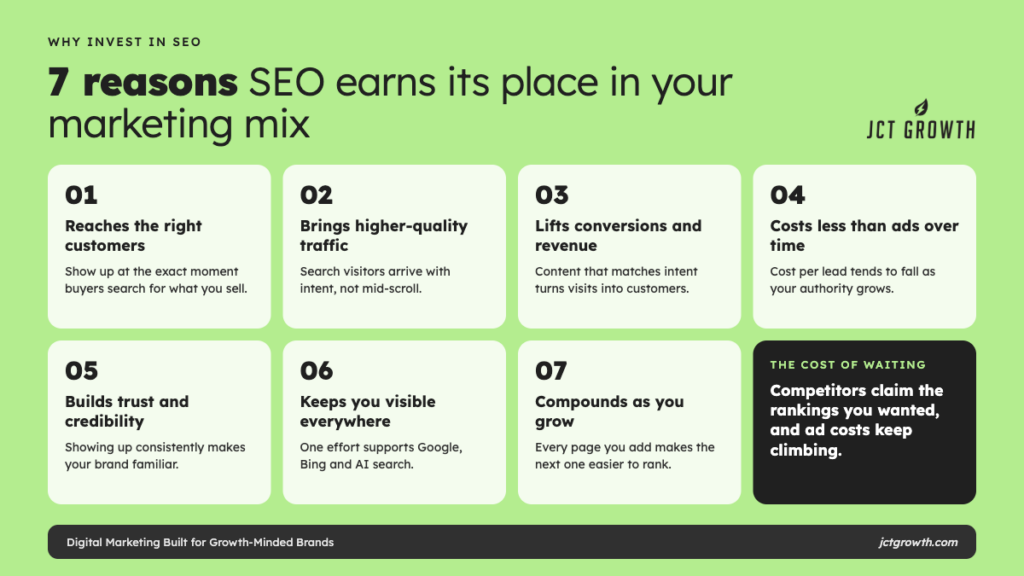
Table of Contents
Key Takeaways
Lorem ipsum dolor sit amet, consectetur adipiscing elit. Ut elit tellus, luctus nec ullamcorper mattis, pulvinar dapibus leo.
1. SEO helps the right customers find you on Google
SEO is one of the most effective ways to grow a business because it builds a digital asset that continuously attracts and converts customers. Unlike paid campaigns that stop working when the budget runs out, a well-executed SEO strategy creates long-term visibility and sustainable revenue.
When someone types a query into Google, they’re telling you exactly what they want. SEO positions your website to appear at that exact moment. Compare that to display ads or social media posts, where you’re interrupting people who weren’t looking for you in the first place.
For businesses that serve specific areas, local SEO adds another layer of value. When someone searches “accountant near me” or “best pizza in Roseville,” they’re typically ready to make a decision. Appearing in those results puts your business in front of real buyers, not browsers.
- Search intent alignment: Your website appears when potential customers are actively looking for what you offer.
- Local visibility: Optimizing your Google Business Profile and location pages helps nearby customers find you when they’re ready to buy.
2. SEO brings higher-quality traffic than most marketing channels
A thousand visitors from a viral social post might generate a handful of inquiries. A hundred visitors from organic search could produce dozens of qualified leads. The difference comes down to intent.
People who find you through search have already taken an action that signals interest. They typed a question into Google, reviewed the results, and chose to click on your page. Someone scrolling through Instagram and stumbling across your brand is in a completely different mindset.
Organic traffic (the unpaid results that appear below any ads) tends to convert at higher rates because visitors arrive with a specific problem they want solved. You’re meeting people where they already are in their buying journey rather than trying to pull them into one.
3. SEO improves your conversion rate and revenue
Ranking for the right keywords brings visitors who are more likely to become customers. When your content matches what someone is searching for, they arrive on your site with expectations you can meet. That alignment between search intent and page content drives conversions.
Think about the difference between someone searching “what is SEO” versus “SEO services for small business.” The first person is researching. The second is evaluating options. If your site ranks for both, you can capture people at different stages, but the second query is much closer to a buying decision.

SEO strategy goes beyond “getting more traffic.” The goal is to attract the right traffic, the kind that actually turns into revenue.
4. SEO costs less than paid ads over time
Paid advertising works like renting visibility. It’s incredibly powerful, but the moment you stop paying, your traffic disappears. SEO works more like building an asset. The content and optimization work you invest in today can continue generating traffic for months or years.
SEO isn’t free. It requires upfront investment in strategy, content creation, and technical improvements, plus ongoing effort to maintain rankings. But unlike paid ads, the cost per lead tends to decrease over time as your content gains authority and your site earns more organic visibility.
| Factor | SEO | Paid Ads |
|---|---|---|
| Traffic after you stop paying | Continues | Stops immediately |
| Cost per click over time | Decreases | Stays the same or increases |
| Trust signals for users | Higher (organic results) | Lower (labeled as ads) |
Many users skip right past the “Sponsored” results because they know those placements were purchased. Organic rankings carry an implicit endorsement from the search engine, which can influence click-through rates and how visitors perceive your brand.
5. SEO builds long-term brand trust and credibility
Showing up consistently in search results does more than drive clicks. It builds familiarity. When someone sees your business appear for multiple relevant searches over time, they start to recognize your brand as a credible player in your space, even before they visit your site.
Google’s quality guidelines emphasize expertise, authoritativeness, and trustworthiness (often called E-E-A-T) as factors that influence how content is evaluated. Sites that demonstrate credibility through quality content, clear authorship, and third-party validation tend to perform better in search. The process of building E-E-A-T signals also strengthens your brand’s reputation with real people.
For competitive or high-consideration purchases, this matters even more. If a potential customer is researching a topic and your content keeps appearing with helpful, accurate information, you’re building trust before they ever fill out a contact form.
6. SEO keeps you visible across Google, Bing, and AI search
Most SEO work focuses on Google because that’s where the majority of searches happen. But the optimization you do for Google also improves your visibility on Bing, Yahoo, and other search engines. You’re not starting from scratch on each platform.
What’s changing is how people search. AI-powered tools like ChatGPT and Google’s AI Overviews are increasingly answering questions directly, pulling information from authoritative sources across the web. If your content is well-structured, accurate, and trustworthy, it’s more likely to be cited or surfaced in AI-generated responses.
- Traditional search engines: Google, Bing, and Yahoo still drive the majority of search traffic, and optimization work applies across all of them.
- AI-powered search: Tools like ChatGPT and Google’s AI Overviews pull from well-optimized, authoritative content when generating answers.
No one can guarantee placement in AI results. But the same principles that help you rank in traditional search, including clear structure, accurate information, and demonstrated expertise, also position your content to be discovered by AI systems.
7. SEO compounds and scales as your business grows
Unlike campaigns with fixed end dates, SEO builds on itself. A blog post you publish today can continue ranking and generating leads for years. As you add more useful content and earn more backlinks, your entire site benefits from increased authority.
A site with strong domain authority and a history of quality content will typically rank new pages faster than a site starting from zero. Early investments create a foundation that makes future efforts more effective.
SEO isn’t a “set it and forget it” strategy. Search algorithms change, competitors publish new content, and your own business evolves. Ongoing optimization, content updates, and technical maintenance keep your site competitive. But the underlying asset you’re building, a library of useful content that attracts qualified visitors, continues to pay dividends over time.
What happens if you wait to invest in SEO?
Competitors take the rankings you wanted
Search results have limited real estate. If your competitors invest in SEO before you do, they can secure the top positions for your most valuable keywords. Displacing an established competitor is harder and more expensive than claiming an open spot, so waiting has a real cost.
Paid acquisition costs keep climbing
As more businesses compete for the same paid ad placements, auction prices tend to rise. Companies that rely entirely on paid channels often find their customer acquisition costs increasing year over year. SEO provides an alternative acquisition channel that isn’t subject to auction-based pricing.
You get left out of AI search results
AI tools are increasingly answering questions directly in search experiences. If your content isn’t optimized, accurate, and authoritative, it’s less likely to be cited or surfaced in AI-generated responses. Businesses that prepare now will have an advantage as AI search becomes more prevalent.
Frequently asked questions about investing in SEO
Is SEO worth the investment for small businesses?
Yes, often more so than for larger companies. Small businesses frequently compete in local markets where keyword competition is lower and customers are ready to buy. SEO can be one of the most cost-effective ways to attract qualified leads without a large advertising budget.
How long does SEO take to show results?
Most businesses begin seeing measurable improvements in rankings and traffic within three to six months, though competitive industries may take longer. SEO works best when treated as a long-term investment rather than a quick fix.
Will AI replace the need for SEO?
AI is changing how people search, but it still relies on optimized content as a source of answers. That makes SEO more important, not less, especially for businesses that want to be cited and discovered in AI-generated responses.
How much should a business budget for SEO services?
Budgets vary based on industry, competition, and business goals. SEO works best when treated as an ongoing growth channel rather than a one-time project. The right approach is to work with a partner who ties SEO recommendations to specific business outcomes rather than just rankings.
Make SEO a growth channel that actually moves your business
SEO works best when it’s aligned with your business goals rather than vanity metrics like keyword counts or traffic volume. The real measure of success is whether organic search is generating qualified leads, conversions, and revenue.
If you’re ready to turn organic search into a real acquisition channel, start a conversation with JCT Growth about what a customized SEO program could look like for your business.