
Most content strategies don’t fail because teams lack ideas. They fail because visibility and storytelling are treated as separate priorities. Over time, the industry has come to equate content volume with progress. In reality, publishing more without a clear structural strategy often creates internal inefficiency rather than business growth.
In one meeting, the SEO team advocates for more optimized pages. In another, the content team focuses on building stronger brand narratives. Both perspectives are valid, but neither is effective in isolation. The result is a growing library of assets. Building more seems productive, but disjoined priorities can struggle to drive meaningful impact on revenue, authority, or market perception.
Search has evolved into a system that rewards alignment. Content builds trust. Architecture enables discovery. When these functions operate independently, performance becomes inconsistent. When they’re unified, visibility compounds over time.
This is no longer a theoretical debate. It is an operational reality.
Table of Contents
Key Takeaways
- SEO and content marketing perform best when treated as one integrated strategy, not two separate workstreams.
- Content marketing fuels SEO by creating indexable, intent-matched pages that build topical authority over time.
- Keyword research should inform content topics, but search intent should drive how each piece is written and structured.
- Topic clusters (pillar pages paired with supporting content) are one of the most effective frameworks for earning topical authority and improving crawl paths.
- On-page optimization means writing for people first and making sure search engines can follow along. It is not about keyword density.
- Generative engine optimization (GEO) is becoming a real part of the visibility equation, and people-first content is the foundation it builds on.
- Meaningful measurement tracks performance across the full funnel. Rankings and traffic are a starting point, not the finish line.
SEO vs. Content Marketing and Where They Overlap
These two disciplines are constantly conflated. The confusion tends to make both less effective. It’s work looking at SEO vs. content marketing before getting into the integration strategy.
SEO is fundamentally about visibility. It covers technical site health, keyword targeting, and link authority. SEO also makes sure search engines can crawl, understand, and rank your content. Think of it as the infrastructure layer.
Content marketing is about creating valuable assets (blog posts, guides, videos, case studies, newsletters) that attract, educate, and convert your audience. Think of it as the construction crew building on top of that infrastructure.
The overlap is where the real opportunity lives. When content topics are informed by keyword data, when every piece is built around search intent, and when on-page optimization is part of the editorial process from the start, that’s integration in action.
| SEO | Content Marketing | |
|---|---|---|
| Primary Goal | Rank higher in search engines; drive organic traffic | Build audience relationships; generate leads and brand awareness |
| Key Outputs | Optimized pages, technical improvements, and backlinks | Blog posts, videos, guides, case studies, social content |
| Core Metrics | Rankings, organic traffic, crawl health, DA | Engagement, time on page, leads, conversions |
| Where They Overlap | Keyword-informed topics, search intent, on-page optimization, distribution, measurement | This is the integration zone where both disciplines reinforce each other |
For a deeper look at building your SEO foundation, check out our SEO strategy resources.
How Content Marketing Helps SEO
The connection between content marketing and SEO is worth getting specific about because understanding the mechanics is what actually changes your approach.
1. More Indexable, Intent-Matched Pages
Every piece of content you publish is another opportunity to rank. But volume alone is not the play. A well-researched post that directly answers what someone is searching for will consistently outperform a generic article targeting the same keyword. Search engines have gotten very good at telling the difference between content written for people and content written to game rankings.
2. Topical Authority
Google doesn’t evaluate individual pages in isolation anymore. It evaluates your site’s depth and credibility on a topic. Publishing a cluster of related content signals that you’re a reliable source, not a site that published one good article three years ago. That matters especially in competitive industries where you’re going up against established players with strong domain authority.
3. Link Earning via Genuinely Helpful Assets
Backlinks remain one of the strongest ranking signals in SEO. The most sustainable way to earn them is to create content that other people want to reference. Original research, comprehensive guides, and proprietary frameworks attract links because they offer something that can’t be found anywhere else. That’s not something you can manufacture through outreach alone.
4. Stronger E-E-A-T Signals
Google’s E-E-A-T framework (Experience, Expertise, Authoritativeness, Trustworthiness) rewards content that demonstrates real-world knowledge. First-person examples, original data, named authors with relevant credentials, and a consistent publishing track record all contribute to E-E-A-T. Keyword density doesn’t.
5. Engagement and Brand Demand
Branded search volume doesn’t get enough attention as an SEO metric. When your content is genuinely useful, people remember your brand and search for it directly. That organic brand demand reinforces your SEO performance in ways that are difficult to replicate through paid channels, which is exactly why building it through content is worth the investment.
This is also why investing in digital marketing services that treat content and SEO as a single strategy (rather than two separate line items) tends to produce better outcomes meaningfully.
What Integration Looks Like in Practice
A large eCommerce retailer, Rugs Direct, partnered with JCT Growth after experiencing years of declining organic visibility. The issue was not one isolated technical gap. It was structural. Duplicate product pages diluted authority, manufacturer-written descriptions provided little unique value, and category architecture failed to reflect how real customers searched. High-intent pages were not surfacing, crawl equity was fragmented, and the brand lacked topical depth in an increasingly competitive category.
Rather than treating SEO as a technical cleanup and content as a stand-alone publishing cadence, the strategy focused on rebuilding both as a unified system.
We redesigned the category architecture to align with real search demand, implemented large-scale canonicalization to consolidate authority, and rewrote thousands of product descriptions to create original, conversion-focused content.
In parallel, we launched an educational content platform designed to capture informational intent while strengthening internal linking between inspiration, research, and transactional pages. The impact was compounding rather than incremental.

Since 2019, Rugs Direct has achieved:
- 15× growth in top-three ranking keywords
- 425% increase in organic traffic
- 191% growth in referring domains
- A content hub now driving over one million visitors annually
Businesses that want to win can’t consider this type of integration as optional. It’s essential.
As search evolves toward AI-driven answer environments, visibility increasingly favors brands that demonstrate structured authority across entire topic ecosystems rather than isolated high-performing pages.
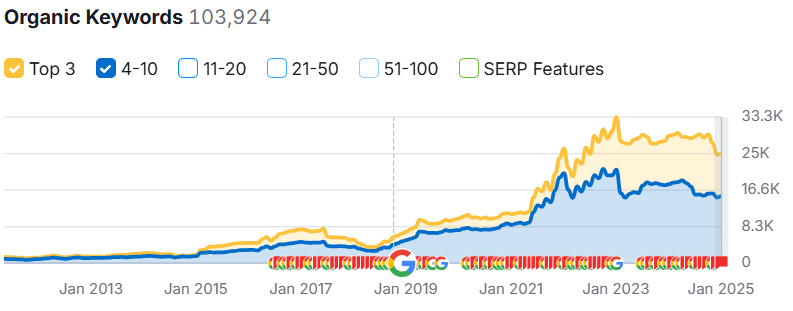
Rugs Direct’s growth illustrates what happens when technical SEO, content strategy, and information architecture are treated as a single long-term growth engine.
This is what we refer to as the Authority Engine. An ecosystem where architecture, content depth, internal linking, and search intent alignment work together to produce compounding visibility rather than isolated ranking wins.
Organizations that build Authority Engines don’t chase traffic. They create environments where discovery becomes inevitable.
The Shared Strategy: Build a Topic Cluster for Topical Authority
If there’s one structural approach that delivers the most SEO and content marketing value at the same time, it’s topic clusters. The model is straightforward.
Pillar page: A comprehensive, authoritative page on a broad topic that links out to all supporting content and serves as the hub.
Cluster pages: Deeper dives into specific subtopics that each link back to the pillar. Together, they create semantic coverage that signals topical depth to search engines.
Example cluster for “content marketing for SEO”:
- Pillar: Content Marketing for SEO (this blog)
- Cluster: How to Do Keyword Research for Content Marketing
- Cluster: Writing SEO-Friendly Content Briefs
- Cluster: Internal Linking Strategy for Content Teams
- Cluster: How to Refresh Underperforming Blog Content
- Cluster: Content Promotion and Distribution Tactics
The cluster structure also improves crawl paths. Search engines follow the internal links through your content ecosystem, which helps them understand the relationship between pages and index everything more effectively.
Keyword Research and SERP Intent (AKA What to Target and Why)
Keyword research is not a list of terms to insert into your writing. It’s a map of what your audience is actually trying to accomplish. That context should shape every content decision you make.
A repeatable approach that works:
- Discover core topics. Start with the broad themes that matter to your audience and work backward to specific queries. Tools like Semrush, Ahrefs, and Google’s autocomplete surface many useful signals here.
- Validate via SERP analysis. Before committing to a topic, look at what’s already ranking. What content types dominate? What questions appear in People Also Ask? What’s the commercial versus informational intent? The SERP tells you what format and angle your content should take.
- Choose primary and secondary keywords. Your primary keyword anchors the piece; secondary keywords are the related terms and questions that naturally belong in the same article. Targeting both improves coverage without making the writing feel forced.
- Define your content angle. With so much content competing for the same rankings, differentiation matters. Original data, a proprietary framework, or real client examples give you something to lead with that generic content can’t replicate.
For more on why intent analysis matters more than ever, see our piece on matching user search intent.
On-Page Optimization That Supports People-First Content
On-page SEO has a bad reputation, mostly because people associate it with keyword stuffing, awkward phrasing, and writing for robots. Modern on-page optimization is the opposite of that. It’s about making your content easier to read, navigate, and understand, which is good for people and search engines alike.
A Quick Checklist for Every Piece You Publish
- Title tag and H1 are aligned (but not identical) and include the primary keyword
- H2s and H3s are scannable and reflect real subtopics, not keyword variations stuffed into headers
- Secondary keywords appear naturally in the body copy, not forced or repeated unnecessarily
- Images have descriptive alt text (this also improves accessibility)
- URL is descriptive and clean
- Schema markup is applied where relevant (FAQ, How-To, Article)
- Internal links point to relevant cluster pages and pillar content
- Meta description is compelling and includes a natural keyword mention
Important Note: Frameworks create clarity. They don’t create momentum. Execution discipline, editorial conviction, and structural alignment do.
Many organizations have well-documented strategies. Far fewer have operating models designed to sustain them.
How GEO Strategies Come Into Play With SEO and Content Marketing
Traditional SEO focuses on ranking in Google’s search results. Generative engine optimization (GEO) focuses on getting cited in AI-generated answers, from ChatGPT to Gemini to Perplexity. The foundation for both SEO and GEO is almost identical.
GEO-optimized content is clearly structured with logical headers, direct and authoritative in tone, rich in original insights and cited data, and genuinely useful rather than keyword-dense. That description also fits the best content marketing. If you’re already producing high-quality, people-first content, you’re building toward GEO visibility at the same time.
The nuances of generative engine optimization strategy go deeper than this section covers. The short version: write for people, optimize for clarity, and you’re on the right track. For a full primer, see our guide on what GEO is.
On the technical side of preparing content for AI consumption, our piece on structuring content for LLMs is worth bookmarking.
Within the next few years, visibility will no longer be determined solely by rankings. AI systems are shifting the discovery layer from lists of links to synthesized answers. In this environment, authority becomes more important than position.
Brands that rely on isolated high-performing pages will see diminishing returns. Those who build interconnected topic ecosystems will increasingly shape the answers themselves.
This transition mirrors earlier shifts from desktop to mobile and from paid-heavy to organic-led growth models. The difference is speed. AI-driven search adoption is accelerating faster than previous platform changes.
Organizations that adapt their content and SEO models now will not simply protect visibility. They’ll define it.
Internal Linking and Content Maintenance
Publishing great content is only part of the equation. It also needs to stay accurate and connect to the rest of your content ecosystem over time.
Internal links pass topical context between pages, distribute link equity through your site, and guide users deeper into your content. Every new piece you publish should link to at least two or three related pages, and existing content should be updated to link back to newer additions.
A healthy content calendar includes a refresh schedule, not just a publishing schedule. In practice, this is called content decay management.
A Practical Linking and Maintenance Cadence:
- Quarterly: Audit for content decay. Pages losing traffic or rankings often just need updated stats, fresher examples, or expanded sections.
- Semi-annually: Review for keyword cannibalization. Multiple pages competing for the same terms dilute your authority. Consolidate where it makes sense.
- Ongoing: Repurpose top-performing content into video, email, or social formats to extend its reach without building from scratch.
- Annually: Review screenshot-heavy or time-sensitive content (tool tutorials, compliance posts) for accuracy.
How Content Marketing Generates Backlinks
Buying links is not a strategy. It’s an action that can only take you so far. The only sustainable approach to link building is earning them, and the best way to earn them is to create content worth linking to.
What Actually Works to Earn Backlinks:
- Original research and proprietary data. If you’ve surveyed your audience, analyzed industry trends, or compiled data no one else has, publish it. Other writers and publications will reference it.
- Comprehensive guides that become reference resources. Not surface-level overviews, but genuinely the most useful thing written on a topic.
- Digital PR. Tying your content to timely news angles or industry events and pitching relevant journalists and publishers. (Check out our deep-dive on digital PR strategies.)
- Community and partner amplification. Sharing insights in industry forums, co-authoring with complementary brands, and contributing to roundups puts your content in front of audiences that already trust the source.
- Linkable assets. Templates, calculators, frameworks, and checklists earn links because they’re tools people return to, not just articles they read once.
The common factor across all of these is value. A strong backlink profile gets built over time by consistently creating content that helps people do their jobs better.
What to Track for SEO and Content Marketing Success
If page views are your only content metric, your measurement strategy needs work. Real integration means tracking performance across the full funnel, from initial visibility through to revenue contribution.
| KPI | What It Measures | Business Relationship |
|---|---|---|
| Keyword Rankings | Visibility for target search terms | Brand discoverability and market positioning |
| Organic Sessions | Volume of non-paid search traffic | Free, scalable pipeline into the funnel |
| Click-Through Rate (CTR) | How often searchers click your results | Strength of title tags and meta descriptions |
| Engaged Time on Page | Content quality and relevance | Indicator of audience fit and E-E-A-T signals |
| Conversions/Leads | Content-driven actions (forms, demo requests) | Direct revenue contribution |
| Assisted Conversions | Content's role in multi-touch journeys | Full-funnel attribution; justifies top-of-funnel investment |
| Backlinks/Referring Domains | Authority signals earned via content | Domain authority growth and long-term ranking power |
| Content ROI | Revenue or pipeline vs. content investment | Justifies budget and resource allocation |
One note on attribution: Assisted conversions are chronically undervalued. That blog post someone read three months before requesting a demo? It contributed. Make sure your conversion attribution setup gives content marketing credit for the full journey, not just the last click.
A Simple SEO and Content Marketing Workflow You Can Copy
A step-by-step process with clear ownership at each stage:
- Keyword and intent research (SEO lead): Identify the target keyword, validate SERP intent, confirm search volume and difficulty, and define the content angle.
- Content brief (SEO + content lead): Document primary and secondary keywords, outline the structure, list internal links to include, specify word count, and note competing content to differentiate from.
- Draft (writer): Write for people first. Cover the search intent, hit the structure, include original insights. Don’t write toward a keyword count.
- SEO review (SEO lead): Check on-page elements (title tag, H1, meta description, internal links, alt text, schema). Flag gaps without rewriting the voice.
- Editorial review (editor): Tighten for clarity, tone, and accuracy. Confirm the content delivers on its promise.
- Design and formatting (designer/editor): Add visuals, callout boxes, tables, or CTAs that improve scannability and engagement.
- Publish and index (SEO lead): Publish, submit to Google Search Console, and update internal links on related pages.
- Monitor and maintain (SEO + content lead): Track rankings and traffic. Flag for refresh if performance drops after 90 to 120 days.
Done means: Published with all on-page elements confirmed, at least two internal links added from related pages, and a 90-day performance review on the calendar.
What to Do If You Get Overwhelmed: Integrating SEO and Content Marketing
Organizations that treat SEO and content as separate investments often experience diminishing returns. An integrated visibility strategy requires structural alignment, editorial rigor, and sustained execution.
For teams navigating this transition, an external perspective can accelerate clarity. At JCT Growth, we partner with organizations to design Authority Engines that compound visibility over time rather than relying on short-term performance spikes.
Explore our content marketing services to see how we can help, or reach out for a free strategy conversation. No pitch, no pressure. Just a straightforward conversation about what’s working, what isn’t, and what it would take to close the gap.
FAQ's
SEO and content marketing work together by combining discoverability with value creation. SEO identifies what people are searching for and how to rank for it. Content marketing creates the assets that satisfy those searches and build audience relationships. Together, they create a system in which content earns organic traffic, and that traffic validates the content investment.
Modern SEO and content marketing are integrated disciplines focused on intent-matched content, topical authority, and genuine audience value, rather than keyword stuffing or publishing for volume. It also increasingly incorporates GEO strategies to gain brand visibility in AI-generated answers across platforms such as ChatGPT and Perplexity.
They're interdependent. SEO without content has nothing to optimize. Content without SEO has no distribution engine. The most effective approach treats them as a single strategy with shared goals, rather than competing budget lines.
Build topic clusters around pillar pages, use keyword research to inform (not dictate) content topics, write for search intent rather than keyword density, maintain a refresh cadence for existing content, and track metrics across the full funnel, not just rankings or pageviews.
Start with a content audit to understand what you already have and where the gaps are. Then, do keyword research to map your target topics to search demand. From there, build a pillar page and cluster structure, establish a content brief process that bakes in SEO requirements from the start, and set up tracking infrastructure to measure results across the funnel.