Most marketing advice focuses on what to start doing. But heading into 2027, what you stop doing matters just as much.
The tactics that built your traffic and pipeline five years ago very well could be working against you at this point. After all, it’s a very different world today. Manual media buying, high-volume content, and cookie-based targeting have all started to hit diminishing returns as AI search, privacy regulations, and algorithm updates changed the rules.
This guide covers the specific practices worth dropping and, most excitingly, where to redirect that budget instead.
Key Takeaways
- What you stop doing in 2027 matters as much as what you start because outdated tactics waste time and money.
- Keyword rankings alone no longer guarantee clicks, so your strategy needs to earn citations in AI-generated answers too.
- One expert-driven piece will outperform several thin posts written to feed the algorithm.
- Reporting on qualified leads, pipeline, and acquisition cost keeps leadership focused on what marketing contributes to revenue.
- First-party data, segmented email, and actively managed paid campaigns replace tactics that relied on cookies and set-and-forget habits.
- Shifting freed-up budget into AI search, expert content, owned audiences, and connected measurement ties marketing back to growth.
Table of Contents
Why the 2020 Marketing Playbook Stopped Working
Manual media buying and generic AI content creation are two practices worth dropping. Automated platforms like Meta’s Advantage+ and Google’s AI-driven bidding systems now handle standard campaign operations more efficiently than a person adjusting bids by hand. Meanwhile, audiences have grown skeptical of shallow content that lacks a real point of view.
Several shifts happened at once. AI search changed how people find information, with Google AI Overviews and tools like ChatGPT answering questions before users click through to websites. Privacy regulations and browser changes limited tracking capabilities. Algorithm updates started rewarding depth and expertise over sheer volume.
As a business that started in 2020, just as the pandemic was beginning, we feel confident about speaking on this topic. We could look back at those first client playbooks with fond memories…because memories are all they’ll be. They’re outdated, and we won’t be relaunching them again.
Why? The answer is easy enough: The tactics that worked five years ago aren’t just less effective. Many actively hurt your results now.
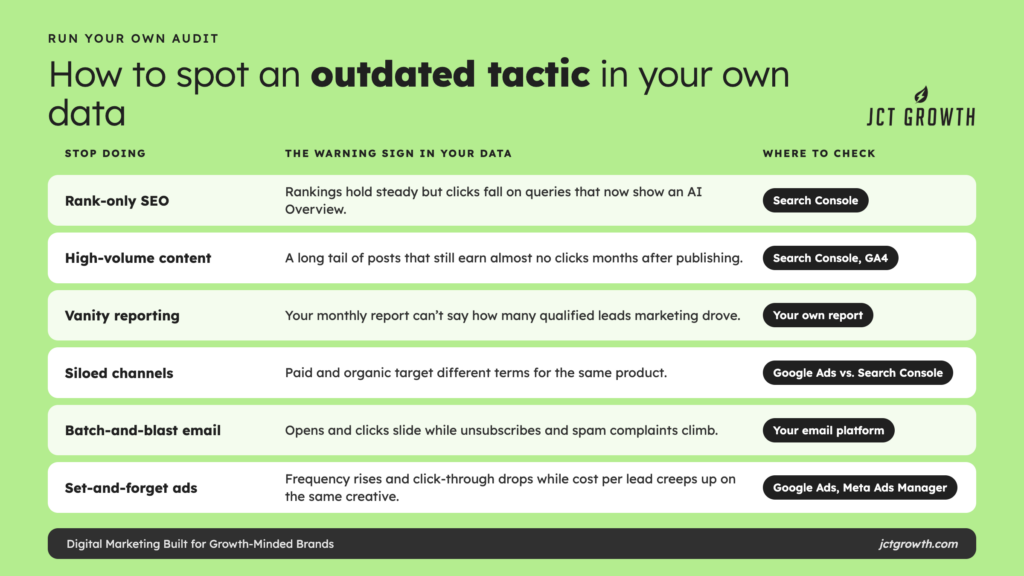
Stop Chasing Keyword Rankings Without AI Search Visibility
Ranking #1 in traditional search no longer guarantees clicks. AI search visibility refers to appearing in AI-generated answers like Google AI Overviews, ChatGPT responses, and Perplexity citations. When an AI overview answers a query directly, users often get what they came for without visiting any website.
If your strategy still measures success purely by keyword position, you’re missing a growing portion of how people actually find answers.

Generative Engine Optimization (GEO) is the practice of structuring content so AI systems can extract and cite it. GEO differs from traditional SEO in a few key ways:
- Traditional SEO: Focuses on ranking for keywords and earning blue links
- AI search visibility: Focuses on being cited as the source AI pulls from, with structured content AI can extract and reference
Stop Publishing High-Volume, Low-Expertise Content
Churning out multiple short blog posts weekly to “feed the algorithm” backfired after Google’s helpful content updates. Google now penalizes generic content that doesn’t add value beyond what already exists.
AI tools can produce commodity content faster than any human team. That’s precisely why human expertise became the differentiator. Content that includes original research, SME insights, or proprietary data stands out because it can’t be replicated as easily.
- Stop: Publishing three thin posts weekly hoping volume drives traffic
- Instead: Publish one deeper piece with real subject matter expert input
Stop Reporting Vanity Metrics That Ignore Revenue
Vanity metrics are measurements like impressions, followers, and page views that look impressive but don’t connect to business outcomes. Leadership tunes out reports filled with them because they don’t answer the question that matters: is marketing contributing to revenue?
| Vanity Metric | Revenue-Connected Alternative |
|---|---|
| Page views | Pages that generate leads or conversions |
| Social followers | Engagement rate from target accounts |
| Email list size | Email-attributed revenue or pipeline |
| Ad impressions | Cost per qualified lead |
When you report on qualified leads, conversion rates, pipeline influence, and customer acquisition cost, you’re speaking the language executives care about.
Stop Running Your Channels in Silos
Siloed marketing happens when teams operate independently without coordination. The SEO team targets different keywords than paid. Email promotes content the blog team didn’t know about. Social posts don’t align with current campaign messaging.
The cost shows up in inconsistent messaging, duplicated effort, and missed opportunities to reinforce the same message across touchpoints. A prospect might see a paid ad, visit your site, receive an email, and encounter three different value propositions.
Integrated strategy connected to business goals fixes siloed marketing, though it requires intentional coordination.
Signs Your Marketing Operates in Silos:
- Paid and organic teams target different keywords for the same product
- Email campaigns promote content the blog team didn’t create
- Social posts don’t reflect current campaign themes
- No shared reporting dashboard exists across channels
Stop Sending Generic Email Blasts to Your Full List
Batch-and-blast email marketing is declining because it damages deliverability, drives low engagement, and increases unsubscribe rates. Email providers have gotten better at filtering out messages recipients don’t want.
The shift toward first-party data makes email list quality more important. As third-party cookies disappear, your email list becomes one of your most valuable owned assets. Treating it carelessly wastes that value.
Better Email Approaches:
- Segmentation: Group subscribers by behavior, purchase history, or engagement level
- Personalization: Tailor content beyond inserting first names
- Triggered sequences: Send based on actions like abandoned carts, content downloads, or inactivity
Stop Setting and Forgetting Your Paid Campaigns
The “set and forget” trap catches many teams. Bidding strategies change, audiences fatigue, creative wears out, and costs creep up without regular attention. A campaign that performed well in month one often declines by month three if nobody’s watching.
Ongoing paid search optimization includes creative refresh cycles, audience testing, bid adjustments, and negative keyword updates. Platforms reward advertisers who actively manage campaigns with better placement and lower costs.
Stop Relying on Third-Party Data and Cookie-Based Targeting
Third-party data comes from entities that don’t have a direct relationship with the user. Cookie deprecation refers to browsers blocking the tracking cookies that made third-party data collection possible. Between privacy regulations like GDPR and state laws, browser changes, and user opt-outs, third-party data has become unreliable.
First-Party Data Alternatives Include:
- Email sign-ups with clear value exchange
- Customer surveys and feedback forms
- On-site behavior tracking with consent
- CRM data from sales interactions
- Contextual targeting based on page content rather than user tracking
Stop Copying Competitors Instead of Interviewing Your Customers
Many marketers reverse-engineer competitor content, ads, and positioning instead of doing primary research. The problem: you’re always reacting, never leading, and you miss what makes your specific audience unique.
On top of that, the truth is that your competitors don’t know your customers as well as you can. That’s an advantage worth using.
Customer Research Methods that Actually Work
- Win/loss interviews with recent buyers and prospects who didn’t convert
- Review mining on G2, Capterra, or industry forums
- Sales call recordings for common questions and objections
- Customer advisory boards or informal check-ins
How to Reallocate the Budget and Hours You Just Freed Up
Phew. Now that all that trimming is out of the way, you have a significant amount of leftover capacity. Now the question is where should you allocate it?
Move Spend Into AI Search and Generative Engine Optimization
Start investing in GEO by creating structured content with authoritative sources that answers questions directly. AI systems cite content they can easily extract and verify.
Fund Fewer, Deeper Pieces of Expert Content
Budget for SME interviews, original research, or data analysis. Expert-driven content is harder for competitors to replicate and more likely to earn citations in media publications and LLMs.
Invest in First-Party Data and Owned Audience Channels
Email lists, SMS programs, and customer data platforms become more valuable as third-party tracking declines. Owned audience channels are assets you control.
Build a Connected Measurement Model
Attribution that ties marketing activity to revenue matters more than channel-specific metrics. Dashboards showing pipeline influence help you make better decisions about where to invest.
Where to Focus Your Marketing Next
The shift is straightforward: stop doing what worked five years ago and start doing what connects to revenue now. That means AI search visibility, expert-driven content, first-party data, and integrated measurement.
Start growing your online presence today by contacting JCT Growth for tailored marketing solutions.
Frequently Asked Questions About What to Stop Doing In Your Marketing
Track the ROI trend over multiple quarters and compare it to alternative tactics. If returns decline consistently while effort stays the same, the tactic is likely obsolete rather than just difficult.
SEO is evolving rather than disappearing. SEO now includes optimizing for AI search visibility alongside traditional rankings.
There's no universal answer, but most businesses benefit from testing a small allocation toward GEO content while monitoring how AI search affects existing organic traffic.
Marketing in 2030 will likely center on AI search visibility, first-party data ownership, and expert-driven content that AI systems can cite. The shift from traditional search rankings to appearing in AI-generated answers is already underway, making structured, authoritative content the primary differentiator.
Automated bidding platforms like Meta's Advantage+ and Google's AI-driven systems now outperform manual campaign management, while privacy regulations force advertisers to rely on first-party data instead of third-party cookies. Creative refresh cycles and audience testing matter more than set-and-forget campaigns.
Businesses that build owned audience channels (like email lists, SMS programs, and customer data platforms) create competitive advantages as third-party tracking disappears. Companies investing in original research, practitioner insights, and proprietary data produce content that competitors can't easily replicate.