As a business owner myself I’ll admit that I know, firsthand, that most marketing plans get written in December and forgotten by February. When JCT Growth was first starting out and we were getting the hang of it, we were definitely guilty of it ourselves. Then, we moved to using a marketing playbook. A playbook works differently because you can reference it, adjust it, and use it throughout the year.
This guide covers how to set goals that tie to revenue, choose the right channels, build for AI search visibility, and roll out your strategy in 90 days.
Key Takeaways
- A marketing playbook works because your team can reference and adjust it all year, unlike an annual plan that’s forgotten by February.
- AI search, rising acquisition costs, and buyer research off your website all mean your 2027 strategy needs to plan for visibility beyond traditional rankings.
- Goals should work backward from revenue, with pipeline contribution and the balance between CAC and LTV showing whether growth is sustainable.
- A specific ideal client profile and a sharp value proposition should drive every channel and messaging decision.
- Auditing what isn’t working before adding new spend frees up budget for the channels that actually reach your buyers.
- A 90-day rollout lets you lock in the foundations, launch priority channels, and adjust based on real performance data.
What a Marketing Playbook Is and Why You Need One Now
A marketing playbook is a documented strategy that connects your goals, channels, and tactics to business outcomes. To build one for 2027, balance high-performing traditional search channels with generative engine optimization (GEO), anchor your budget in verified brand trust, and define full-funnel metrics that go beyond lead generation.
The playbook format works because it gives your team a single reference point they’ll actually use, rather than a static annual plan that collects dust and doesn’t change as new variables or priorities are added throughout the year. Buyer behavior and search technology are shifting faster than most planning cycles can keep up with. A playbook built for flexibility lets you adjust quarterly without starting over.
What's Changed in Marketing Since Your Last Playbook
AI Search and Zero-Click Behavior
AI Overviews and answer engines now provide direct responses to many queries, which means fewer clicks to your website even when your content is the source. Zero-click search refers to queries where the user gets their answer directly on the search results page without clicking through. Your playbook needs to account for visibility in AI-generated responses, not just traditional organic rankings.
Rising Customer Acquisition Costs and Tighter Budgets
Paid media costs have climbed steadily across most platforms, and leadership teams are asking harder questions about marketing ROI. Your playbook can’t focus only on top-of-funnel awareness anymore. You’ll want to show how marketing actually generates more qualified leads and revenue.
Buyer Research Happening Off Your Website
Prospects now research on LinkedIn, Reddit, review sites, and AI assistants before they ever visit your website. By the time someone fills out a contact form, they’ve often already formed an opinion about your company. Your playbook needs to address visibility and reputation in places you don’t control.
Setting Marketing Goals and KPIs That Tie to Revenue
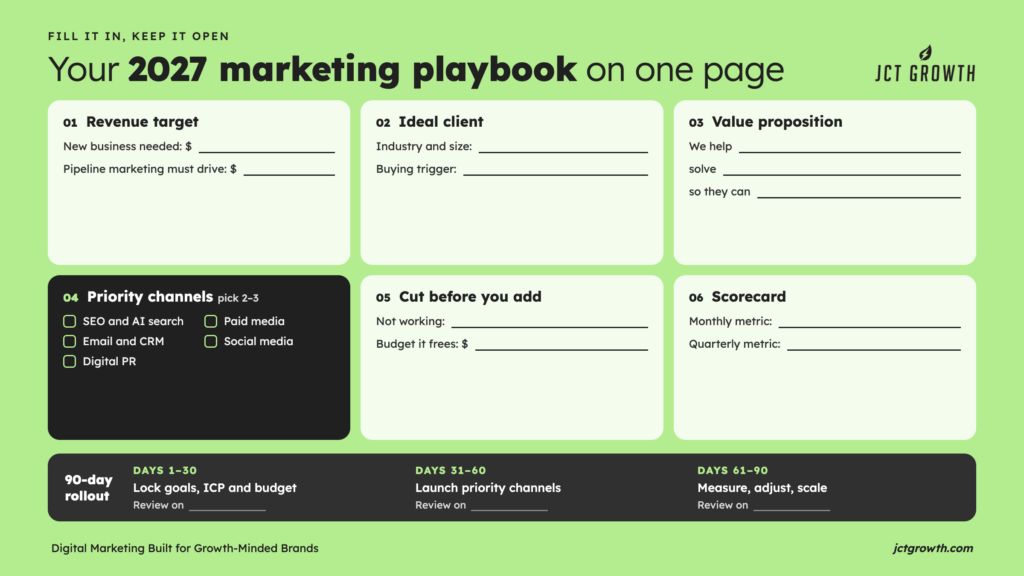
Goals that connect to business outcomes are more useful than vanity metrics like impressions or follower counts. Start by working backward from your revenue target, then identify the marketing activities that contribute to that number.
- Revenue target: If sales needs $2M in new business, how much pipeline does marketing need to generate or influence?
- Pipeline contribution: Marketing-sourced leads originate from marketing efforts. Marketing-influenced deals are touched by marketing at some point in the buyer journey.
- CAC and LTV: Customer acquisition cost (CAC) tells you what you’re spending to win a customer. Lifetime value (LTV) tells you what that customer is worth over time. The ratio between them determines whether your growth is sustainable.
- Leading indicators: Traffic, MQLs, and engagement metrics serve as early signals that your strategy is working before revenue shows up.
Defining Your Ideal Customer and Value Proposition
Building an Ideal Client Profile
An ideal client profile (ICP) describes the companies or individuals most likely to buy from you and succeed with your product or service. Include firmographics like industry, company size, and location, along with pain points and buying triggers. Your ICP drives channel selection and messaging later, so it’s worth getting specific here.
Sharpening Your Value Proposition
Your value proposition explains what makes your offer different in one or two sentences. It answers the question: why would your ICP choose you over alternatives? Tie it directly to the problems your ICP actually has, not the features you’re proud of.
How to Plan Your Marketing Budget for the Year Ahead
Splitting Spend Between Growth and Retention
The right balance between acquiring new customers and expanding existing accounts depends on your business model. A SaaS company with strong retention might invest more heavily in acquisition, while a services business with high churn might prioritize customer success and upsell campaigns first.
Deciding What to Cut Before You Add
Before allocating new budget, audit what you’re already spending. Look at channel performance over the past 12 months and identify underperformers. Cutting a campaign that isn’t working frees up resources for something that might. If 2027 is forcing you to do digital marketing on a budget, being the most honest with yourself and asking hard questions has to be a part of your planning process.
| Budget Category | Questions to Ask |
|---|---|
| Paid media | Is CAC sustainable? Which platforms conver? |
| Content | Are we producing assets that rank or generate leads? |
| Tools/software | Are we using what we're paying for? |
| Agency/contractor | Is the ROI clear or documented? |
Choosing the Right Marketing Channels for Your Playbook
Channel selection follows your ICP and goals, not trends. A B2B company selling to enterprise buyers will prioritize different channels than a local service business.
SEO and Organic Search
One of the clearest reasons to invest in SEO right now is that organic search remains a compounding channel. Content you publish today can generate traffic for years. SEO now includes optimizing for AI search visibility, which we’ll cover in more detail below.
Paid Media
Paid search and social advertising accelerate results and let you test messaging quickly. Paid channels are especially useful for new offers or entering new markets where you don’t yet have organic visibility.
Email and CRM
Email is owned media, meaning you control the audience and the message. Email marketing is particularly effective for nurturing leads who aren’t ready to buy and for retaining existing customers.
Social Media
Social platforms build brand visibility and community. The right platform depends entirely on where your ICP spends time. LinkedIn works well for B2B; Instagram might make more sense for consumer brands.
Digital PR
Earning media coverage and backlinks builds authority that supports both traditional SEO and AI search visibility. Third-party validation from trusted publications signals credibility to search engines and prospects alike.
Building an SEO and AI Search Visibility Strategy
SEO now includes optimizing for answer engines, sometimes called AEO (Answer Engine Optimization) or GEO (Generative Engine Optimization). Answer engines pull information from web content to generate direct responses, so your content needs to be structured for extraction.
Writing clear, direct answers to common questions helps. So does using structured formatting like headers and lists. AI systems also check third-party proof like reviews, mentions, and backlinks before recommending a brand.
Content Strategy and Production That Compounds Over Time
Running Focused Content Sprints
Sprint-based content production helps teams ship faster and stay aligned with business priorities. Rather than maintaining a never-ending content calendar, sprints focus effort on a specific goal for a defined period. JCT Growth uses sprint-based delivery with clients to produce high-quality content without the bottlenecks of traditional workflows.
Prioritizing Topics That Match Buyer Intent
Matching your marketing to user search intent is key in 2027. Choose topics based on what your ICP is searching for and where they are in the buying journey. Early-stage content might answer broad questions, while late-stage content addresses specific objections or comparisons.
Lead Generation, Nurturing, and Sales Handoff
Qualifying Leads Before Sales Sees Them
Not every form fill deserves a sales call. Lead scoring or qualification criteria help ensure sales receives higher-quality opportunities. Scoring factors might include company size, budget, or specific actions taken on your site.
Nurturing with Email and Retargeting
Leads who aren’t ready to buy still need attention. Different types of email campaigns, automated sequences, and retargeting ads keep your brand visible while providing value. The goal is to be helpful, not annoying.
Client Retention and Expansion Strategies
Playbooks often focus heavily on acquisition and neglect post-sale marketing. Retention tactics like onboarding emails, regular check-ins, and cross-sell campaigns often cost less than acquiring new customers. Retention efforts can also significantly increase lifetime value.
Measuring Performance and Reporting to Leadership
Track metrics at different intervals and connect them to business outcomes:
- Monthly: Channel performance, lead volume, pipeline contribution
- Quarterly: CAC trends, revenue attribution, campaign ROI
- Annually: Year-over-year growth, LTV changes, market share indicators
Reports for leadership work best when they’re clear and free of jargon. Executives want to know what’s working, what isn’t, and what you’re doing about it.
Staffing Your Playbook with In-house, Agency, or Fractional Support
| Model | Best For | Trade-offs |
|---|---|---|
| In-house team | Deep brand knowledge, daily execution | Higher fixed costs, slower to scale |
| Agency partner | Specialized expertise, flexible scope | Requires clear communication, less control |
| Fractional marketing | Strategic leadership without full-time cost | Part-time availability, depends on fit |
Many companies use a hybrid approach. An agency like JCT Growth can handle execution while your team stays focused on strategy…or the other way around. Whatever your marketing needs, we’re here to help.
A 90-day Rollout Plan for Your New Marketing Playbook
1. Finalize Goals, ICP, and Budget in the First 30 days
Lock in foundational decisions before launching campaigns. Involve sales and leadership to ensure alignment on targets and priorities.
2. Launch Priority Channels and Content in Days 31 to 60
Start with the highest-impact channels based on your ICP and goals. Begin content production sprints focused on your most important topics.
3. Measure, Adjust, and Scale in Days 61 to 90
Review early performance data. Double down on what’s working and pause what isn’t. The playbook format pays off here because you can adjust without rewriting everything.
Put Your Playbook into Motion with JCT Growth
JCT Growth helps businesses build and execute customized marketing playbooks with strategic guidance and hands-on execution. We connect SEO, content, paid media, and analytics around your specific goals and resources.
Start growing your online presence today by contacting JCT Growth for tailored marketing solutions.
Frequently Asked Questions About Building a Marketing Playbook
The 3-7-27 rule proposes a prospect needs to see your brand three times to recognize it, seven times to remember it, and twenty-seven times before they're ready to buy.
Length matters less than clarity. A useful playbook is detailed enough to guide execution but concise enough that your team will actually reference it.
Review your playbook quarterly and update it whenever there's a major shift in your business goals, market conditions, or channel performance.