Every marketing channel promises results. The challenge is figuring out which ones actually make sense for your business, your audience, and your budget.
The right mix depends on where your customers spend time online and what you’re trying to accomplish. This guide walks through the major digital marketing channels, how to evaluate them, and how to build a strategy that connects your investment to real growth.
Key Takeaways
- The right digital marketing channels depend on where your audience spends time online and what your business is trying to achieve.
- Matching channels to your sales cycle keeps your budget focused, with paid search suited to fast decisions and content and email suited to longer ones.
- Two or three channels done well will outperform five channels spread thin.
- Paid ads deliver faster results but stop when spending stops, while SEO and content build lasting value over time.
- Most businesses grow best by starting with one intent-capture channel and adding nurturing, authority, and reach as they learn what works.
- Measuring each channel by leads, sales, and revenue shows you what to continue, adjust, or stop.
What Digital Marketing Channels Are and Why the Mix Matters
A digital marketing channel is any online platform or method used to reach potential customers, whether that’s a search engine, social media platform, email inbox, or paid ad placement. The right digital marketing channels for your business depend on where your target audience spends time online and what goals you’re trying to achieve.
Most businesses see better results from a combination of channels working together rather than putting everything into one. The specific mix varies based on your industry, how your customers buy, your budget, and your timeline. A B2B software company and a local med spa might both invest in SEO, but the rest of their channel mix will look quite different.
How to Choose the Right Digital Marketing Channels for Your Business
Picking channels isn’t about copying what competitors do or chasing whatever platform is trending. It starts with understanding your own situation and making choices based on evidence.
1. Define Your Business Goals and What Growth Looks Like
Different goals call for different channels. Before evaluating options, get specific about what you’re actually trying to accomplish.
- Brand awareness: Social media and content marketing build visibility over time with audiences who don’t know you yet
- Lead generation: Paid search and SEO capture people actively looking for solutions like yours
- Direct sales: Paid advertising and email marketing drive immediate purchases or sign-ups
- Customer retention: Email and social media marketing keep existing customers engaged and encourage repeat business
A business focused on generating qualified leads will prioritize channels differently than one trying to build recognition in a new market.
2. Know Your Target Audience and Where They Spend Time
Channel selection starts with understanding where your audience already is. A B2B software company’s buyers are on LinkedIn and reading industry publications. A local med spa’s clients are on Instagram and searching Google for treatments near them.
Research beats guessing here. Look at your existing customer data, survey your audience, or analyze where competitors are active.
3. Match Channels to Your Sales Cycle and Buying Behavior
Longer, complex sales cycles benefit from nurturing channels like email and content marketing. Shorter cycles can focus more on paid search and local SEO.
| Sales Cycle Type | Best-Fit Channels |
|---|---|
| Short or impulse purchases | Paid social Paid search Local SEO |
| Considered purchases | SEO Content marketing Email nurturing |
| Long B2B sales cycles | Content marketing Digital PR |
4. Set a Realistic Budget and Resource Plan
Some channels require more investment than others. Paid ads require ongoing spend to maintain results. SEO requires time and consistent content production before returns show up.
Limited digital marketing budgets mean focusing on fewer channels done well rather than spreading thin across many. A common mistake is launching five channels at once, doing none of them effectively, and concluding that “marketing doesn’t work.”
5. Weigh Short-term Wins Against Long-term Growth
Paid advertising delivers faster results but stops when you stop paying. SEO and content marketing take longer to build but create compounding value over time.
Most businesses benefit from a blend of both, using paid channels to generate near-term results while building organic visibility for the long run.
Digital Marketing Channels Worth Considering
Understanding your options helps you make informed decisions. Below is what each major channel offers and where it fits best.
Search Engine Optimization
SEO (search engine optimization) improves your website so it ranks higher in organic search results. Organic results are the non-paid listings that appear when someone searches on Google or another search engine.
SEO works best for businesses where customers actively search for what they offer. If people type questions or product names into Google looking for solutions like yours, SEO can put you in front of them.
- On-page SEO: Optimizing your website content, titles, and structure so search engines understand what each page is about
- Off-page SEO: Building backlinks (links from other websites to yours) that signal authority and trust
- Technical SEO: Site speed, mobile-friendliness, and making sure search engines can crawl and index your pages
SEO takes time, often several months before meaningful results appear. However, it builds a traffic source that doesn’t disappear when you pause spending.
Local SEO for Location-Based Businesses
Local SEO is a specialized branch of SEO for businesses serving specific geographic areas. If customers search for services “near me” or in a particular city, local SEO matters.
- Google Business Profile: A free listing that appears in Google Maps and local search results. Essential for showing up when people search for businesses in your area.
- Local citations and directories: Consistent name, address, and phone number across business directories and review sites
- Reviews: Customer reviews on Google and other platforms influence both local rankings and buyer decisions
Healthcare practices, service businesses, and retailers with physical locations typically see strong returns from local SEO.
Paid Search and Paid Social Advertising
Pay-per-click (PPC) advertising means you pay each time someone clicks your ad. Paid search places ads in Google search results when people search for specific terms. Paid social places ads on platforms like Facebook, Instagram, and LinkedIn.
Paid channels work well for businesses that want leads quickly or want to test messaging before investing in organic content. Costs vary significantly by industry and competition. A personal injury attorney pays far more per click than a local bakery because the value of each case is much higher.
Content Marketing
Content marketing creates valuable content to attract and engage your audience. Blog posts, guides, videos, and downloadable resources all fall under content marketing.
Content works particularly well for businesses with longer buying cycles or complex products that require education before purchase. It also supports SEO by giving search engines something to rank, and it provides material to share via email and social media.
Email Marketing
Email lets you communicate directly with people who’ve opted in to hear from you. Two main uses stand out.
First, nurture sequences move leads toward a purchase decision over time by sending relevant information at each stage. Second, retention emails keep existing customers engaged and encourage repeat business.
Email is one of the few channels you fully own and control. Algorithm changes on social platforms or search engines don’t affect your ability to reach your email list.
Social Media Marketing
Organic social media means non-paid posting on platforms like Facebook, Instagram, LinkedIn, and TikTok. It’s best for building brand awareness, community, and staying top-of-mind between purchases.
Organic reach (how many people see your posts without paid promotion) has declined on most platforms over the years, so social often works best paired with paid social or content marketing. Different platforms suit different audiences:
- LinkedIn: B2B companies and professional services
- Instagram: Visual brands, lifestyle businesses, healthcare and aesthetics practices
- Facebook: Local businesses and community building
Digital PR and Influencer Marketing
Digital PR earns media coverage and backlinks from journalists, bloggers, and publications. Influencer marketing partners with people who have engaged audiences in your niche.
Both build credibility and reach new audiences. Digital PR strategies and influencer marketing work best for brands ready to invest in relationship-building and storytelling rather than expecting immediate, directly measurable conversions.
AI Search Visibility and Generative Engine Optimization
AI tools like ChatGPT and Google’s AI Overviews are changing how people find information. Generative engine optimization (GEO) focuses on making your content visible in AI-generated answers.
GEO is still evolving, but it’s worth monitoring for businesses that rely heavily on search traffic. At JCT Growth, we include AI search visibility as part of our SEO and content strategy work.
How to Sequence and Combine Marketing Channels Over Time
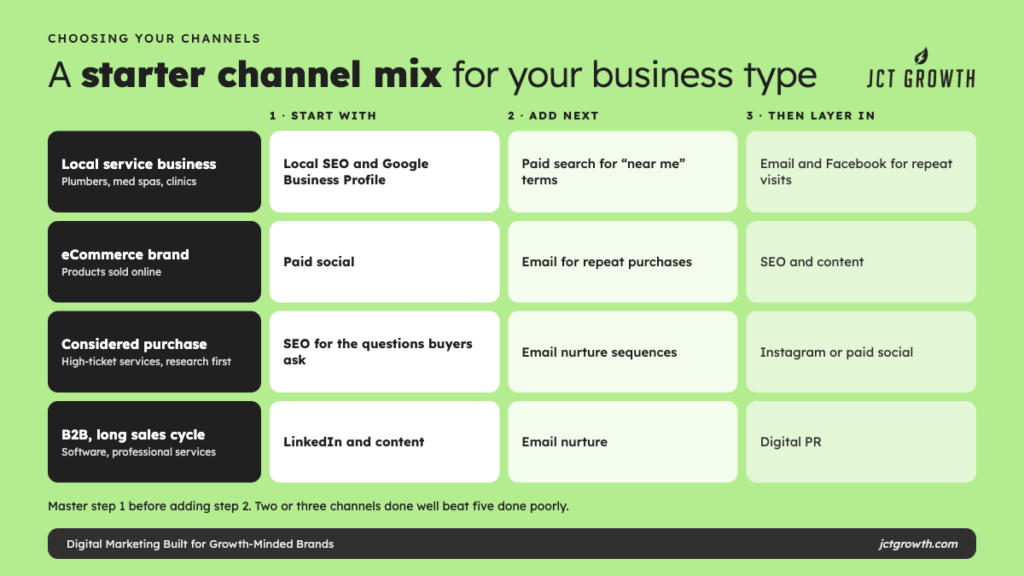
Channel strategy isn’t set-it-and-forget-it. Most businesses start with one or two channels, then expand as they learn what works.
- Start with intent-capture: If people search for what you sell, begin with SEO or paid search to reach them when they’re actively looking
- Add nurturing: Once traffic flows, add email marketing to convert visitors and retain customers
- Build authority: Layer in content marketing and digital PR to grow organic reach and credibility
- Expand reach: Add social media or paid social to reach new audiences who aren’t searching yet
The order varies by business type. An eCommerce brand might start with paid social, while a B2B company might lead with LinkedIn and content.
How to Measure Whether a Marketing Channel is Working
Each channel has different metrics that matter:
- SEO: Organic traffic, keyword rankings, conversions from organic visitors
- Paid ads: Cost per click, cost per lead, return on ad spend
- Email: Open rates, click rates, conversions from email
- Social: Engagement, reach, referral traffic to your website
Track conversions like leads, sales, and revenue rather than just vanity metrics like followers or impressions. Clear reporting helps you decide what to continue, adjust, or stop.
Build Your Channel Strategy with JCT Growth
Figuring out which channels fit your goals, audience, and budget takes research and experience. At JCT Growth, we help businesses connect SEO, paid marketing, content, email, social media, digital PR, and AI search visibility into a cohesive program.
Our approach combines strategic guidance with hands-on execution and clear reporting so you understand what’s working. If you’re not sure where to start or want help connecting your channels to real business results, reach out to our team.
FAQ's About Different Digital Marketing Channels
Most small businesses do better focusing on two or three channels done well rather than spreading resources across many. Start with the channels that best match your goals and audience, then expand as you have capacity.
It depends on your timeline and budget. Paid advertising delivers faster results but requires ongoing spend, while SEO builds slower but creates lasting value.
Paid advertising can generate traffic within days, while SEO and content marketing typically take several months to show meaningful results. Email marketing results depend on the size and engagement of your list.
If a channel consistently fails to deliver leads or conversions after a reasonable testing period and optimization efforts, it may not be right for your business. Before dropping it entirely, make sure you've given it enough time and properly tracked results.