
In 2026, people no longer rely solely on Google to discover products, services, or information. Users increasingly begin their search journey with AI-powered platforms like ChatGPT, Claude, Perplexity, and even Google’s own AI Overviews. Instead of clicking through a list of links, they often find an answer via synthesized, AI-generated answers. That means your brand has to show up where these models look for data, context, and authority.
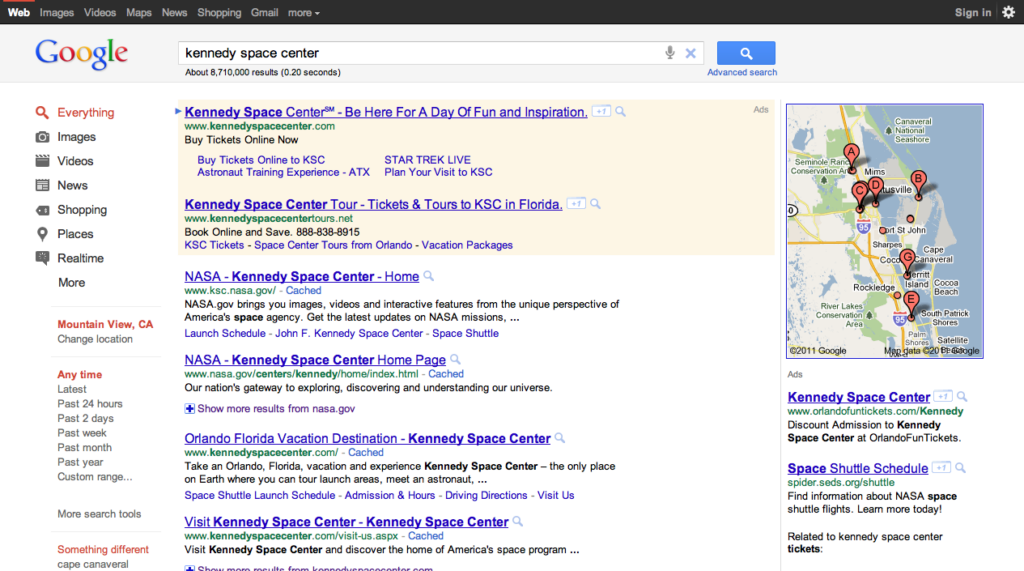
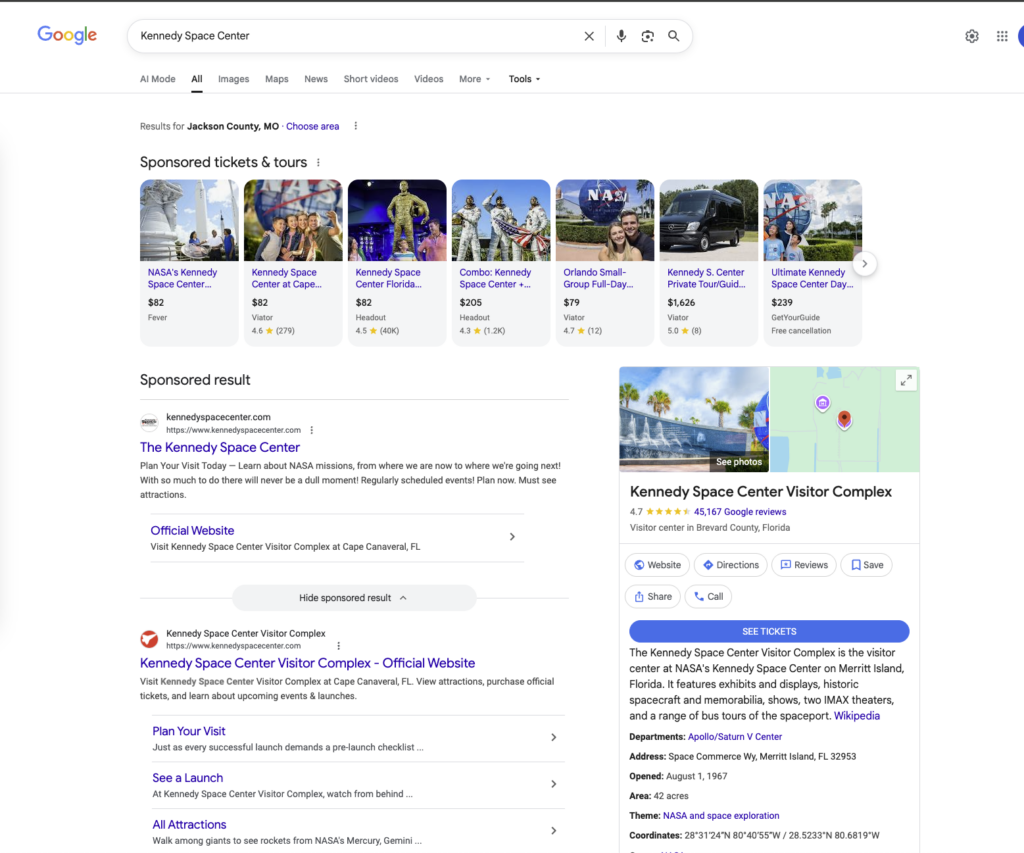
The same SERP today, complete with Knowledge Graph, Shopping tools, and featured results.
Improving brand visibility in AI search requires more than traditional SEO. It demands clear content architecture, authoritative references, structured data, and visibility across the platforms AI models rely on.
Quick Insights for Marketing Leaders
AI search is reshaping discoverability. Even major players that dominate traditional search rankings are at risk. Brands that adapt early gain a compounding advantage, while those that ignore it risk losing visibility.
- AI search visibility relies heavily on source authority, clarity, and recency.
- Structured data, brand mentions, and citations meaningfully influence LLM outputs.
- AI search expands beyond Google. Models pull from social, video, forums, and authoritative knowledge bases.
- Content older than 12 months is increasingly less likely to be cited, creating an opportunity to refresh older, outdated content.
- Conversational keywords and natural language patterns are essential to match AI-driven queries. Focusing on keywords alone won’t suffice.
Trust the Hype: AI Search Visibility Matters for Businesses Right Now
AI assistants are quickly becoming the first stop for guidance, recommendations, and research. But instead of offering a list of links, LLMs synthesize answers. Visibility hinges on being referenced, recommended, or cited by the model.
Consumers are using tools like OpenAI ChatGPT, Perplexity, Claude, and Gemini to find products, compare services, and gather advice. If your brand isn’t part of the sources these systems rely on, you’re simply invisible to some searchers (aka customers), even if your traditional SEO program is strong.
Understanding How AI Search Engines Source Information
We know that AI search engines merge insights from multiple data streams, but what does that look like in practice? As models continue to evolve, they may source details from the following spots around the web:
- Training data: Books, articles, websites, transcripts, public datasets)
- Live web crawling: Retrieval-augmented updates)
- Structured signals: Schema, metadata, product attributes)
- Trusted sources: High-authority websites and expert profiles)
- Real-time context: Current conversations and social signals)
If your brand doesn’t appear in the ecosystems models already trust, then you’re unlikely to be recommended.
| Source Type | Why It Matters |
|---|---|
| High-authority websites | Models prioritize well-structured, editorially rigorous sources |
| Wikipedia | A top trust signal when brands meet notability standards |
| Publisher partners (e.g. OpenAI Publisher Program) | Directly influence which sources models reference |
| Reddit, Quora, and other forums | Conversion-based insight and sentiment signals |
| Social channels, video/audio transcripts, podcasts | Highly crawable and context-rich |
| Structured data | Helps models understand entities, relationships, and attributes |
Fresh, Accurate, and Well-Referenced Content Drives AI Brand Visibility
As mentioned before, LLMs reward clarity, accuracy, and recency. Content older than one year – especially if unreferenced – loses visibility in AI-generated answers.
To support AI brand visibility, your pages should be:
- Factually accurate
- Supported by citations from reputable sources
- Linked to relevant internal and external resources
- Updated with current statistics
- Structured in a descriptive, Wiki-style format
Models look for well-supported claims and topical completeness. If your competitors are updating faster, their information becomes the version AI systems trust.
Optimizing Content for Conversational Queries
Content that mirrors these patterns performs dramatically better. That’s why one of the best ways to improve brand visibility in AI search results is to include the following elements in your content:
- Conversational phrasing
- Related phrases and synonyms
- Long-tail, context-rich keywords
- FAQs that directly match user phrasing
- Summaries and scannable key takeaways
AI search is conversational at its core. Users ask natural-language questions like:
- “What’s the best way to improve brand visibility in AI search?”
- “How do I get my website to appear in ChatGPT answers?”
- “I need a new recommendation for a water bottle that fits well in a Patagonia Black Hole 25L water sleeve. I’d prefer something metal, but I’m not picky.”
Let’s look at that last example. Here’s a screenshot of the query in Google’s AI Mode:
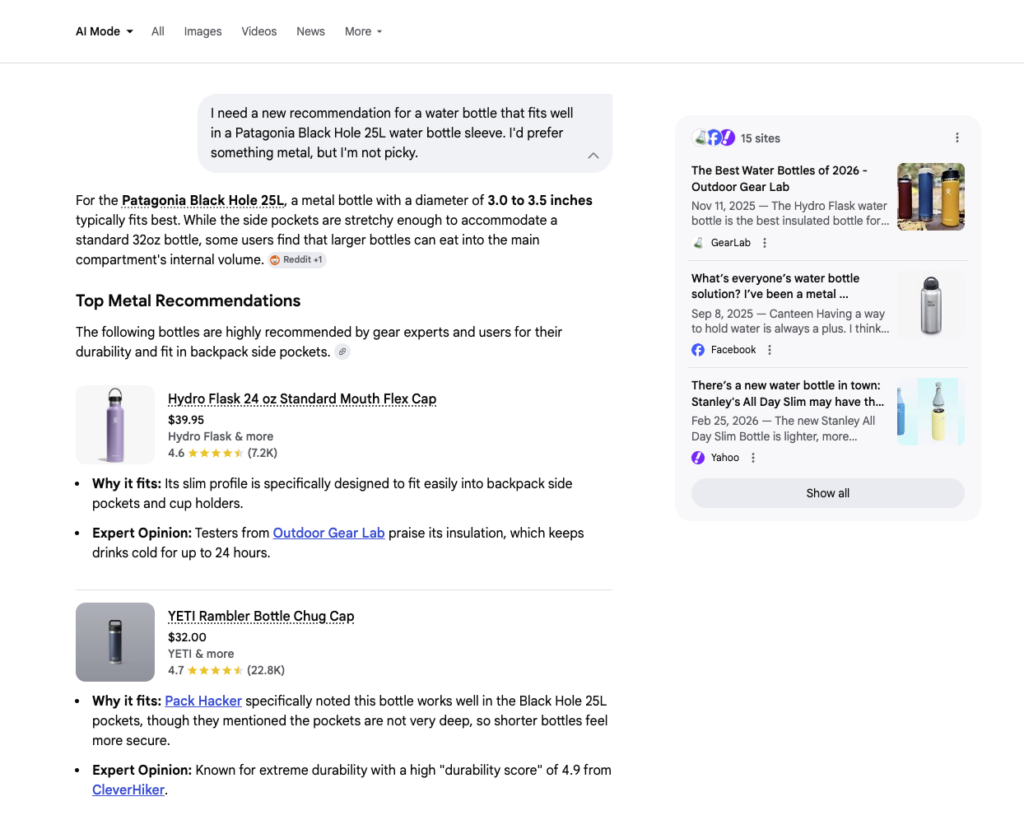
Notice that, as part of the AI search results, Google supplied external sources with additional context. They’re linking out to knowledgeable resources like Outdoor Gear Lab, CleverHiker, and even a Facebook post asking a similar question.
Digging deeper, check out how the Outdoor Gear Lab water bottle review is formatted. There’s a ton of context here, with varying answers depending on your needs.
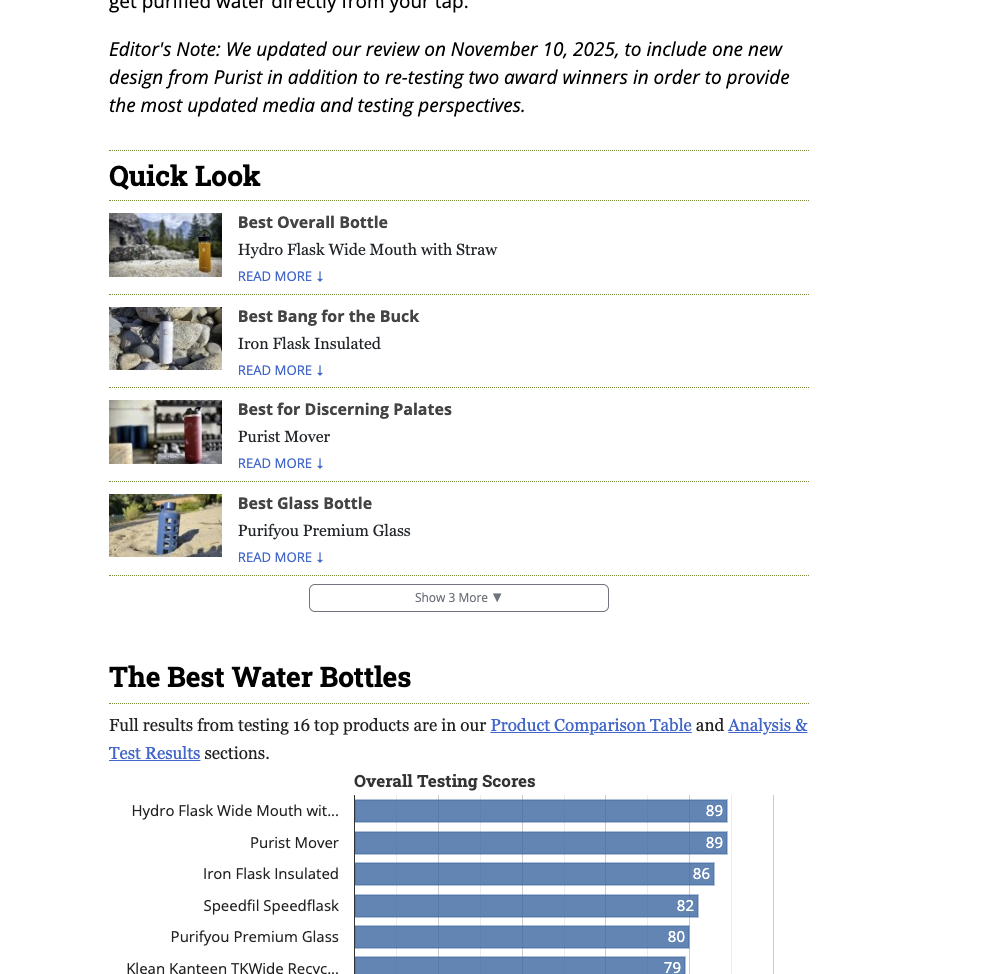
The best way to make sure you’re showing up in these results is to match user intent by creating content that answers specific questions with clarity and context.
Content Clarity, Structure, and E-E-A-T Signals Matter More Than Ever
AI models extract and reorganize content. A clear structure makes that easier.
| Element | Why It Matters |
|---|---|
| Strong table of contents (TOC) | Helps models interpret page structure and hierarchy |
| Clear H2/H3 heading hierarchy | Reinforces topical organization |
| Summaries & scannable points | Improves machine readability |
| Author bios & credentials | Reinforce authority (E-E-A-T) |
| Mixed media (video, images, transcripts, tables) | Adds context that models can parse |
The Increasing Role of Structured Data in AI Search Visibility
Schema markup clarifies entities, roles, and relationships, making it easier for AI systems to understand what your brand does.
Examples of Useful Schema
Organization Schema
This schema helps search engines and LLMs understand and display key details about your business, such as its logo, address, contact information, and more.
					{
  "@context": "https://schema.org",
  "@type": "Organization",
  "name": "JCT Growth",
  "url": "https://jctgrowth.com",
  "sameAs": ["https://www.linkedin.com/company/jctgrowth"]
}
Product + Offer Schema
Brands can use Product + Offer schema to define a product’s name, description, and important purchasing info for search engines. This often converts standard search listings to “rich results” and adds to visibility.
					{
  "@context": "https://schema.org",
  "@type": "Product",
  "name": "AI Visibility Audit",
  "brand": "JCT Growth",
  "offers": {
    "@type": "Offer",
    "price": "0",
    "priceCurrency": "USD"
  }
FAQ Schema
FAQ Schema helps search engines and LLMs identify and display question-and-answer information directly. It also provides visibility via “rich snippets” like collapsible FAQ dropdowns in the SERP.
					{
  "@context": "https://schema.org",
  "@type": "FAQPage"
}
Article Schema
The article schema identifies a page’s headline, author, publication date, and images. This can help it show up in rich snippets like “Top Stories” carousels.
					{
  "@context": "https://schema.org",
  "@type": "Article",
  "headline": "How to Improve Brand Visibility in AI Search"
}
Anchor Schema
Author schema identifies a content creator and allows search engines and LLMs to understand who wrote a piece, verify their experience, and establish trust.
					{
  "@context": "https://schema.org",
  "@type": "Person",
  "name": "Your Author Name"
}
Authority Building Through Brand Mentions and Citations
AI systems seek external confirmation. When your brand appears in authoritative sources – media coverage, Wikipedia, industry publications – it becomes far more likely to be included in AI-generated answers.
Excellent strategies that increase brand visibility in LLMs and brand authority include:
- Maintaining active brand mention campaigns
- Securing digital PR placements
- Building journalist-friendly resource pages
- Encouraging citations from reputable publications
- Assessing whether your brand qualifies for a Wikipedia page
Social Platforms as AI Visibility Engines
AI models train on high-engagement public platforms. Strong cross-channel activity and a focused social media strategy improve visibility. Consider these elements and actions for each of the popular social platforms to support AI brand visibility:
Instagram & Facebook
- Keyword research & trending topics
- Speech/text/caption optimization
- Influencer & creator strategies
- Hashtag relevance
- Video-first content planning
YouTube
- Optimized titles, descriptions & transcripts
- Video gap opportunities
- Channel audit improvements
- Storyboarding & production
- Trend identification
- Sentiment analysis
- Digital PR + brand mentions
- High-authority community participation
TikTok
- Keyword-enabled scripts, captions & speech
- Influencer collabs
- Short-form video planning
- Channel growth strategies
Podcasts
- Interviews
- Digital PR
- Cross-promotional content
- Mixed media recaps
- Social amplification
Search Everywhere Optimization: Beyond Google
AI search visibility doesn’t live in one platform. Models aggregate signals from video, forums, social channels, news sources, transcripts, and structured data. As more users engage with these alternatives to Google, it’s absolutely vital to approach your optimization strategy with these platforms in mind. Brands that diversify visibility improve their competitiveness as AI search expands across ecosystems.
Targeting OpenAI Publisher Partners
Publisher Partners have a meaningful influence on which sources are prioritized in model responses. Optimizing for these outlets can help your brand appear more frequently in AI answers because their content is often prioritized as a resource.
AI typically treats backlinks or mentions from high-authority sites as signals of factual reliability, so references on these platforms are really powerful. But you need to be critical about how you approach this, too. Journalists are under immense pressure, which means human-centered, spontaneous (but specific) pitches work best. Using platforms like HARO or Featured.com to provide your responses to queries within the first two hours is a great way to get noticed.
If you haven’t built one yet, consider a digital press kit with high-res headshots, lists of previously covered topics, and a “ready to use” bio. Schema markup can be helpful here, too, as it will help AI models connect your expertise to your niche.
The real differentiator for inclusion in AI results is original data. Conduct surveys or analyze your own data to find trends. By providing statistics, you become a primary source. Other publishers will often cite you, which creates authority that an LLM can’t ignore.
Timely, Up-to-Date Content Improves AI Retrieval
While many AI models rely on training data, they’re increasingly focused on “real-time” web browsing. That means crawling live sites for current answers; as a result, outdated information may be less visible for these “live” agents.
To maintain content freshness, consider:
- Content age: Aim to ensure high-priority pages are regularly updated. Search engines often filter results by date to ensure users get the most current solutions.
- Refresh cycles: Establish quarterly or annual refresh cycles to audit facts, statistics, and links. Replace outdated information or broken links.
- Trend monitoring: Google Trends and industry-specific news aggregators can help you catch changes in trends when they occur. Noticing these changes and updating accordingly before your competitors can make you a better source for AI models.
- Version updates: Pay attention to update cycles for best practices or major tools. Updating your content accordingly can signal “active management” of content.
Data-driven oversight makes a world of difference when managing content. With a content performance dashboard, you can track which pages are losing traction.
The Role of Long-Tail Keywords in AI Discovery
Long-tail queries power conversational AI search.
Users aren’t just searching – they’re asking:
- “What’s the best AI-friendly marketing strategy for a small business?”
- “How do I get my company cited in AI answers?”
Specific, problem-oriented content gives models more reason to surface your brand.
How JCT Growth Improves Brand Visibility in AI Search
JCT Growth optimizes visibility far beyond Google. Our content marketing strategy blends:
- Conversational, AI-ready content
- Multichannel visibility across social, video, forums, and podcasts
- Digital PR and authority-building
- Structured data implementation
- Technical SEO + AI search optimization
- Continuous monitoring and refresh cycles
The result: your brand shows up everywhere your audience looks. Yes, even inside AI answers.
Knowing how to elevate your search strategy to better meet the LLM moment is a significant part of our SEO services.
Contact us today to learn more.
FAQ's
Brands can increase visibility by publishing authoritative content, using structured data, building citations across trusted sources, staying active across social and conversational platforms, and maintaining accurate, up-to-date information that models can trust.
LLMs prioritize credibility, recency, clarity, and external confirmation. Data sources like Publisher Partners, Wikipedia, digital PR, social conversations, and structured data all play a role.
Structured data helps AI systems understand key entities, relationships, and attributes. Schema creates predictable patterns that models can reliably interpret, improving retrieval accuracy.
Yes. SEO focuses on ranking within search engines, while AI search optimization focuses on being included in model-generated answers. The overlap is significant, but the mechanics differ.
AI models reference public conversations and authoritative citations. High-engagement content, creator partnerships, news coverage, and expert quotes all increase the likelihood of appearing in AI-generated summaries.