
Search visibility is complicated these days. Google’s not the lone player anymore, and even its search results look a lot different compared to just two years ago.
It’s not necessarily a bad thing, but it is different.
Between AI Overviews (AIO), generative search answers in LLMs, and conversational search interfaces, users increasingly find answers to their questions without clicking a traditional “blue link.” That means SEO teams can’t rely on rank tracking alone to understand performance.
Luckily, there’s a solution: AI search monitoring platforms.
While they’re a recent development, these platforms go beyond basic SEO functions to measure things like AI citations, topic coverage, brand mentions inside AI answers, and shifts in SERP features. They help SEO understand where your brand appears in AI-powered search experiences, not just whether you rank.
Table of Contents
Key Takeaways
- AI-driven search features make traditional rank tracking incomplete for measuring visibility.
- AI search monitoring platforms track citations, topic coverage, and brand mentions in AI-generated answers.
- Integrating AI visibility data with GSC, GA4, and keyword tools gives a fuller picture of SEO performance.
- Combining these datasets helps identify content gaps, intent shifts, and optimization opportunities faster.
- Dashboards in Looker Studio or BigQuery can unify the data for ongoing reporting and decision-making.
What “AI Search Monitoring” Means
Before we get into any of that, though, it’s important to define AI search monitoring as it separates from brand monitoring of yesteryear.
Traditional SEO measurement is often straightforward: track rankings, monitor impressions and clicks, and analyze traffic. AI-powered search isn’t as straightforward. Instead of presenting a list of results, search engines and LLM platforms often generate summarized answers using information from multiple sources. Your content might influence an answer even if a user never clicks through to your page.
AI search monitoring often focuses on things like:
- Citations in AI answers
- Brand mentions within AI-generated summaries
- Topic or entity coverage across search experiences
- SERP feature changes affecting visibility
While traditional rank tracking still matters, it’s no longer the whole story. Pure SEO-focused tools may not give you visibility into AI-specific factors.
Example: Say your website or page ranks #3 for a specific keyword. That’s great! But if an AIO summarizes the answer and cites two other sources instead of yours, your effective visibility could still be low. The user gets their answer without even hearing your contribution to the conversation.
AI monitoring tools can help reveal that gap. They don’t replace rank tracking (which can still be quite important). Instead, they add context around how search experiences are evolving.
5 Core AI Search Monitoring Platform SEO Benefits
AI search monitoring platforms give you a ton of data. What you do with that data is important. It should inform your decision-making at every step. Investing in an AI search monitoring platform gives you critical value:
1. SERP Monitoring at Scale
AI search monitoring tools track changes across AIOss, featured snippets, knowledge panels, and generative answer modules. This can help your team understand when visibility drops are caused by SERP feature changes versus ranking shifts.
2. Keyword and Topic Visibility Insights
These tools don’t think only in terms of keywords. They often analyze topic coverage and entity relevance. This helps answer questions like:
- “Are we visible for this topic cluster?”
- “Which competitors see more frequent AI answer citations?”
- “Where do we lack topical authority?”
This kind of insight is hard to get from standard keyword tools alone.
3. Competitive Benchmarking
AI visibility tools can make it easier to see who search engines trust for answers. For example, you might discover that a competitor is frequently cited in AI responses or how another brand dominates informational queries in your category. These insights can guide your content strategy and help determine digital PR tactics to build authority.
4. Content Gap Discovery
One of the fastest wins from AI monitoring platforms is in identifying missing coverage areas. If AI consistently references topics your content doesn’t cover, it’s often a signal to expand or refresh pages to bring up those details.
5. Faster Optimization Feedback Loops
Traditional SEO changes may take weeks to evaluate; however, AI monitoring platforms can often help detect visibility changes sooner, especially those tied to AI citation frequency, SERP feature appearances, and competitor mention patterns. This ultimately makes testing and optimization much more responsive.
Data Mapping: How to Integrate AI Visibility Analytics with SEO Tools
AI visibility tools aren’t a replacement for your existing SEO data sources. They’re powerful because they consolidate key fields from different tools to deliver a unified view of what’s going on in LLMs and how it relates to your brand.
Each tool answers a different question. Together, they help connect search demand, visibility, engagement, and outcomes.
| Data Source | Key Fields | What It Tells You |
|---|---|---|
| Google Search Console (GSC) | Queries, impressions, clicks, average position | Demand signals and ranking performance |
| GA4 | Sessions, engagement rate, conversions | How traffic behaves after landing |
| Semrush/Ahrefs | Keyword difficulty, backlinks, keyword clusters | Competitive landscape and topic coverage |
| AI searchmonitoring platform | AI citations, mentions, SERP feature presence | Visibility inside AI-driven search experiences |
How to Integrate AI Visibility Analytics With Google Search Console
Google Search Console (GSC) remains the foundation of most SEO reporting, but when you combine it with AI visibility analytics the results are much more powerful. A practical workflow can look like this:
- Export GSC query and page data: Focus on queries with high impressions and pages ranking in positions 1-10.
- Overlay AI visibility data: Identify queries that trigger AI Overviews, pages cited within AI answers, and pages ranking but not referenced.
- Identify opportunity patterns: Look for signals like high impressions and declining click-through rates (CTR). You may also analyze strong rankings that lack AI citations or competitors who’ve been cited instead of you.
- Prioritize updates: Focus first on those pages with high demand and strong ranking potential. You’ll also want to seek out those with low AI visibility. That’s your weekly optimization queue.
How to Integrate With GA4 (and Why Engagement + Conversion Context Matters)
Visibility alone doesn’t equal success. If AI search features drive traffic but visitors aren’t engaging or converting, the visibility isn’t doing much for the business. That’s where careful integration with GA4 matters.
A good workflow might look like:
- Segment landing pages by AI visibility change.
- Compare engagement rate and conversion metrics.
- Evaluate whether visibility improvements translate to meaningful outcomes.
Here’s an example: You might discover that pages gaining AI citations also show higher engagement, more assisted conversions, and better lead quality. The opposite could also be true. Either way, GA4 data ensures you’re optimizing for more KPIs than impressions.
How to Integrate With Semrush/Ahrefs for Keyword, Content, and Competitive Insights
Even if keywords aren’t the “end all, be all” of SEO these days, tracking platforms are still essential for planning and prioritization. When you combine them with AI visibility analytics, they become an even bigger strategic tool.
Focus on topics where you see high business value keywords and moderate existing rankings. This, combined with strong competitor presence in AI answers, can signal quick-win opportunities.
Here’s an example: Imagine a competitor who dominates AI citations for a topic, but your page is already in the top 10. Improving structure and clarity might significantly increase your visibility. Keyword clustering tools from Semrush or Ahrefs can help ensure content covers the full topic landscape, increasing the chances an AI system will reference it.
Use Cases That Directly Improve SEO Outcomes
Theory is one thing, but let’s talk about how teams can actually use these tools:
- Prioritizing content refreshes: Instead of refreshing random pages, teams can identify those that rank but aren’t cited in AI results – prime update candidates.
- Detecting cannibalization and intent shifts: AI monitoring can reveal when multiple pages compete for the same topic, or if search engines interpret intent differently. This helps you consolidate or restructure content.
- Identifying citation opportunities: When AI answers references specific statistics, frameworks, or definitions, you can create clear, structured explanations of those topics to increase citation likelihood.
- Spotting visibility drops linked to SERP changes: Sometimes rankings can stay stable while traffic drops. AI monitoring can help uncover whether AI Overviews replaced clicks, new SERP features appeared, or if competitors gained citations.
- Validating content updates: After refreshing a page, you can track increases in AI citations or whether your SERP feature presence improved. This can also uncover if there are competitors who aren’t mentioned as much.
Reporting: How to Build an AI Visibility Monitoring Dashboard
Once your data starts to come in from multiple sources, reporting gets messy fast. But a centralized dashboard can solve the problem. AI visibility monitoring dashboards combine:
- AI visibility metrics
- Search demand data
- engagement signals
- competitive insights
Typical structure for these dashboards can include four sections:
| Visibility | Demand | Outcomes | Competitive Landscape |
|---|---|---|---|
| ✔ AI citations | ✔ Impressions | ✔ Sessions | ✔ Competitor citations |
| ✔ SERP feature appearances | ✔ Query volume trends | ✔ Engagement rate | ✔ Topic share of voice |
| ✔ Ranking distribution | ✔ Topic clusters | ✔ Conversions | ✔ SERP feature ownership |
The end result is a dashboard where SEO leaders can quickly answer questions such as:
- Are we visible?
- Is demand increasing?
- Are users engaging?
- Are competitors gaining ground?
These answers translate into actions your business can take to reclaim visibility and grow your online presence on both Google and LLMs.
Taking the Extra Step: Exploring LLM Queries
Once you understand your visibility on AI platforms (how often you’re showing up), the next step is uncovering what queries are earning you those spots. That’s where a query explorer comes in. This tool lets you see what phrases people are actually using when they search on ChatGPT, Claude, or other LLMs.
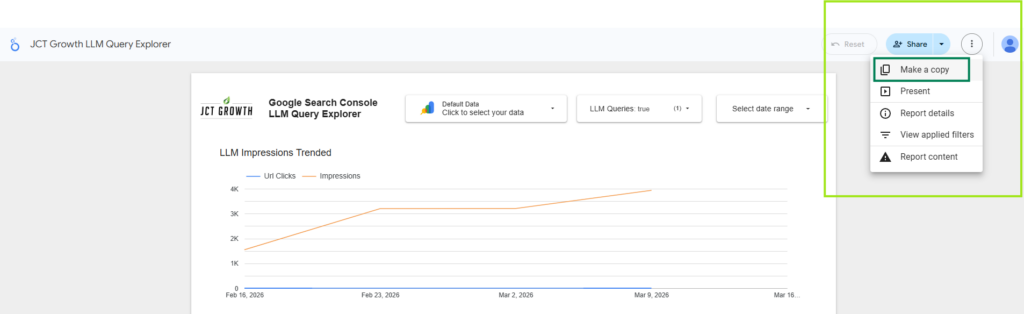
To get started using JCT Growth’s LLM Query Explorer, all you have to do is:
1. Make a copy of the tool and save it to your local drive.
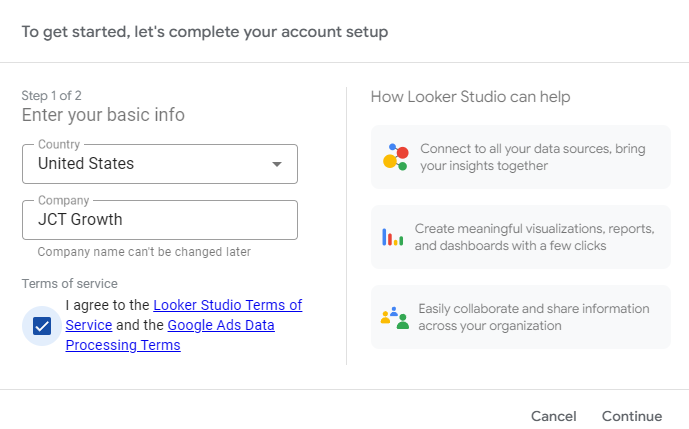
2. Make sure you’re logged into Google, or follow these steps to set up an account to access and utilize the dashboard properly.
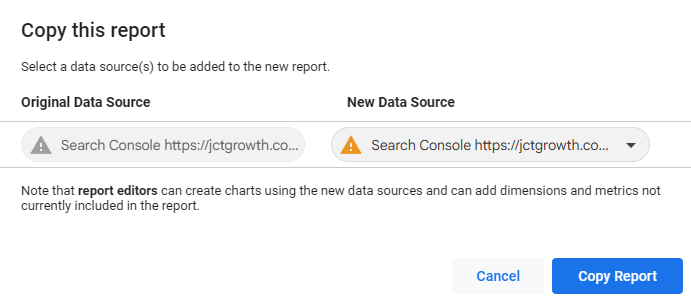
3. When prompted, connect your new data source.
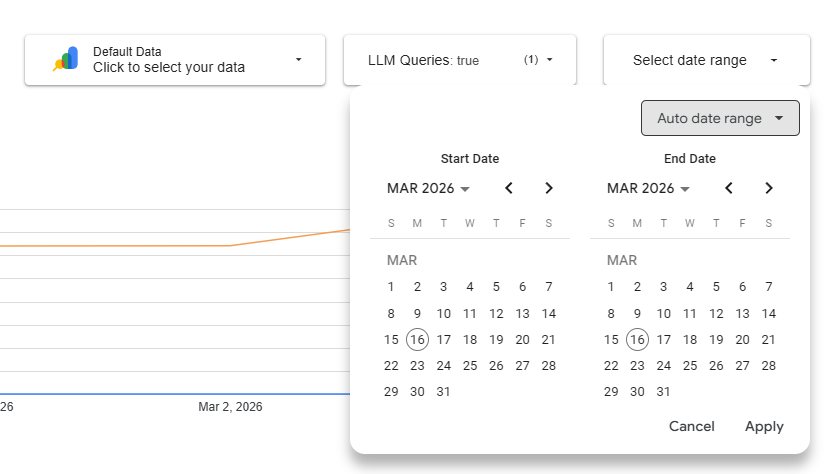
4. Start adjusting parameters such as the date range so you can view unique AI query insights.

Best Practices and Guardrails (Aligning With Google Search Essentials)
No matter what your AI insights show, they should guide SEO strategy without replacing the fundamentals. The core principles still matter: people-first content that offers clear topical coverage with accurate sourcing. Technical site optimizations with a crawlable site architecture and compliance with Google spam policies.
AI monitoring platforms can help you prioritize the work, but they’re not shortcuts. Search engines will still reward helpful information and credible expertise. Think of it this way:
AI visibility analytics are a navigation tool, not a magic lever.
Of course, navigating this new frontier alone isn’t always the best or easiest choice for in-house teams. If you have questions about optimizing your website for AI search, our team can help.
The experts at JCT Growth are here to answer your questions about technical SEO optimization, GEO strategy, and content marketing.
FAQ's
Having an AI search monitoring platform in your toolbelt is valuable because it unifies data from different sources and sheds light on how your brand performs in LLMs. With unified, multi-channel data on your side, your SEO strategy can be tailored to address both changes in SERPs, LLMs, and user behavior quickly.
Traditional SEO focuses on rankings and clicks. LLM-optimized content considers how AI systems interpret and summarize information. That means clearer structure, strong topical coverage, and authoritative explanations that AI systems can confidently cite.
Use clear headings, concise explanations, and structured information. Pages that answer questions directly, include definitions or frameworks, and demonstrate topical authority are more likely to be referenced by AI-generated summaries.
Not dramatically. The biggest shift is toward clarity and completeness. Content that explains concepts well, answers specific questions, and covers topics thoroughly tends to perform well in both traditional and AI-driven search.