Most SaaS companies treat their SEO strategy like a checkbox. They write and publish blog posts, sprinkle in keywords, and wait for traffic. Then they wonder why organic search isn’t generating signups or demos.
SEO for SaaS works differently because the business model works differently. The sales cycle is longer. Depending on your product, the conversion pathways and conversations might take longer to nurture. Instead of a one-time purchase, you’re building recurring revenue from customers who might stay for years.
This guide covers how to build a SaaS SEO approach around that reality, from keyword research and content strategy to technical priorities and measuring what actually matters for growth.
Table of Contents
Key Takeaways
- SaaS SEO works best when it’s built around recurring revenue, not traffic or keyword volume alone.
- Longer sales cycles and buying committees mean your content has to answer different stakeholders at every stage of research.
- Organizing content into conversion, demand, and education hubs gives every page a clear job in the buyer’s journey.
- High-intent, lower-volume keywords often drive more pipeline than broad informational terms, especially for newer SaaS sites.
- Technical issues like JavaScript rendering and weak site architecture can quietly limit how much of your content gets indexed.
- Organic signups, pipeline, and MRR prove SEO’s value in ways rankings alone can’t.
Why SaaS SEO requires a different playbook than traditional SEO
SEO for SaaS businesses focuses on turning organic search traffic into recurring revenue by aligning keyword choices with user intent and business goals. That’s a different objective than ranking for high-volume keywords or driving one-time purchases. SaaS companies sell subscriptions, so the value of a customer compounds over months or years. Your SEO approach has to reflect that.
Generic SEO advice often falls short for software companies because it doesn’t account for how SaaS buyers actually research and purchase. A B2B SaaS product might have a sales cycle measured in weeks, with multiple stakeholders weighing in before a decision. Meanwhile, a product-led SaaS tool might convert users through a free trial with no human interaction at all.
Longer sales cycles and buying committees
Most SaaS purchases involve more than one person. IT evaluates security. Finance reviews pricing. End users care about features and usability. Your content has to serve each of those roles at different stages of their research. A single blog post won’t close a deal when three departments have questions.
Product-led vs. sales-led SEO
Product-led growth (PLG) companies like Notion or Calendly focus on free trials and self-service signups. Their SEO targets keywords around templates, how-to content, and free tools that lead directly to product usage. Sales-led companies prioritize demo requests and contact forms, so their SEO emphasizes comparison pages, ROI calculators, and bottom-funnel content that generates qualified leads.
Ranking factors unique to SaaS
Software review sites like G2 and Capterra influence how prospects evaluate your product, and they often rank for your brand name. Branded search volume signals demand to search engines. Documentation and help center content build topical authority. None of that applies the same way to eCommerce or local businesses.
The core components of a revenue-driven SaaS SEO strategy
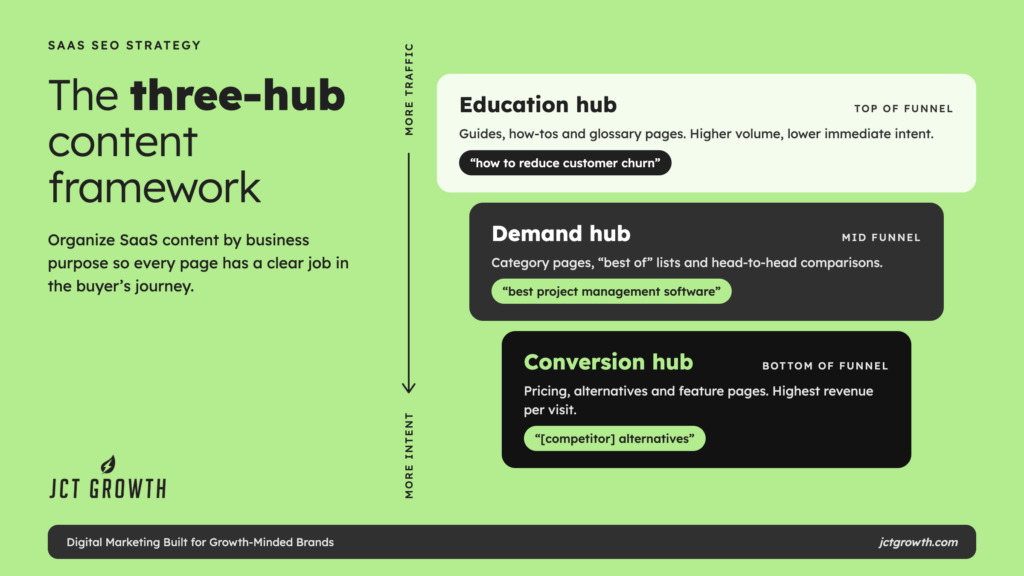
A useful content marketing framework organizes SaaS content into three hubs based on business purpose: conversion, demand, and education. Each hub serves a different stage of the buyer’s journey and contributes differently to revenue.
The conversion hub for bottom-funnel buyers
Conversion hub pages target people ready to buy: pricing pages, comparison pages (your product vs. competitors), alternatives pages, and feature pages. A well-optimized “[Competitor] alternatives” page can capture traffic from people who’ve already decided to switch. Visitors here have the highest revenue impact per visit because they’re actively evaluating options.
The demand hub for category and competitor searches
Demand hub content captures people searching for your category or competitor names. Think “best project management software” listicles, “[Competitor] vs [Your Product]” comparisons, and category definition pages. Visitors at this stage know they have a problem and are researching solutions.
The education hub for top-of-funnel traffic
Educational blog content, guides, and resources attract people earlier in their journey. The tradeoff is clear: higher volume but lower immediate conversion intent. A guide on “how to reduce customer churn” might bring thousands of visitors, but most aren’t ready to buy today.
Product-led SEO content
Free tools, calculators, templates, and interactive content can rank well and generate signups directly. Product-led content differs from educational content because it delivers immediate product value. Ahrefs’ free backlink checker and HubSpot’s website grader are classic examples.
How to do keyword research for a SaaS product
SaaS keyword research requires understanding your product’s use cases and buyer language, not just chasing search volume. A keyword with 50 monthly searches that brings demo requests often beats one with 5,000 searches that brings casual readers.
1. Start with your product and core use cases
Begin with what your software actually does and the problems it solves. List out features, use cases, and jobs-to-be-done as keyword seeds. If your product helps sales teams track deals, your seed keywords might include “sales pipeline management,” “deal tracking software,” and “CRM for small teams.”
2. Map keywords to the SaaS buyer's journey
Different keyword types fit different stages:
| Stage | Keyword Type | Example |
|---|---|---|
| Awareness | Problem/question keywords | "how to reduce customer churn" |
| Consideration | Category/comparison keywords | "best subscription management software" |
| Decision | Brand/competitor keywords | "[product name] vs [competitor]" |
3. Find high-intent commercial keywords
High-intent keywords include words like pricing, demo, free trial, reviews, or specific feature names. “[Software category] pricing” or “[Your product] free trial” signals someone close to a decision.
4. Analyze competitor and alternatives searches
Find keywords your competitors rank for and identify gaps. “[Competitor] alternatives” and “[Competitor] vs [your brand]” patterns capture people actively considering a switch.
5. Uncover feature and integration keywords
SaaS buyers search for specific capabilities. “CRM with Slack integration” or “project management software with time tracking” targets people with defined requirements.
6. Validate with search volume and business value
Prioritize keywords based on volume, difficulty, and business alignment. A low-volume keyword with high purchase intent often delivers more revenue than a high-volume informational keyword.
How to build SaaS content that maps to the buyer's journey
Once you’ve identified keywords, the next step is creating content that matches what searchers actually want to find. This also helps boost brand visibility in AI search.
Comparison and alternatives pages
Comparison pages capture bottom-funnel traffic from people actively evaluating options. Structure them with a fair comparison, your advantages, and clear CTAs. Honest comparisons build trust; overly promotional ones don’t convert.
Feature and integration pages
Create SEO-optimized pages for individual features and integrations. Feature pages target specific use-case keywords and support product-led growth by showing exactly how your product solves particular problems.
Educational and category content
How-to guides, glossary pages, and “what is [category]” content build topical authority and capture earlier-stage searches. Educational content also creates internal linking opportunities to your conversion pages.
Programmatic SEO for scalable coverage
Programmatic SEO uses templates and data to generate many similar pages. SaaS examples include integration pages, location pages, and use-case pages. The risk is thin content; each page still has to provide genuine value.
Thought leadership and original research
Original data, surveys, and expert perspectives earn backlinks and differentiate you from competitors. Thought leadership supports both SEO and brand building with digital PR.
Technical SEO priorities for SaaS websites
SaaS sites face specific technical challenges that generic SEO advice doesn’t address.
- JavaScript rendering: Many SaaS sites use React, Vue, or Angular, which can cause indexation issues. Server-side rendering or dynamic rendering often solves this.
- Site architecture: Keep important pages within a few clicks of the homepage. Internal linking between product pages and blog content helps crawlers and users.
- Page speed: SaaS sites often have heavy dashboards and interactive elements. Focus on landing page and blog performance for SEO.
- Schema markup: SoftwareApplication, FAQPage, and HowTo schema help with rich snippets and AI search visibility.
- Subdomains vs subfolders: Documentation on a subfolder (/docs/) typically consolidates authority better than a subdomain (docs.yoursite.com).
Link building for SaaS companies
SaaS companies have unique link building opportunities that other businesses don’t.
- Data-driven research: Original research, industry reports, and benchmark data naturally attract links. SaaS companies have access to unique product usage data that journalists and bloggers cite.
- Digital PR and founder commentary: Executives can contribute expert quotes to journalists through services like Connectively (formerly HARO) or direct outreach digital PR strategies.
- Integration partnerships: Integration partners often link to each other’s sites through partner directories and co-authored content.
- Guest contributions: Writing for relevant industry blogs and trade publications builds authority when it’s genuine thought leadership, not guest post spam.
How to measure SaaS SEO impact on pipeline and revenue
Rankings alone don’t prove SEO value. The metrics that matter connect organic traffic to business outcomes.
- Organic signups/trials: New users from organic search
- Organic MQLs: Marketing qualified leads attributed to SEO
- Pipeline influenced: Revenue in pipeline where organic was a touchpoint
- Organic MRR: Monthly recurring revenue from organic-sourced customers
First-touch and multi-touch attribution models help you understand how SEO contributes across the buyer’s journey. AI search visibility is also becoming important; monitoring brand mentions and referral traffic from ChatGPT, Perplexity, and Google AI Overviews provides early signals.
Common SaaS SEO mistakes to avoid
- Treating the blog as the whole approach: A blog-only approach misses conversion-focused pages, product-led content, and technical improvements.
- Ignoring search intent on product pages: Product and feature pages often target keywords without matching what searchers actually want to find.
- Chasing high-volume keywords too early: New SaaS sites benefit from starting with lower-competition, higher-intent keywords before competing for broad terms.
- Neglecting site migrations: Redesigns and platform changes can destroy organic traffic if SEO isn’t involved in planning.
- Skipping content refreshes: SaaS content becomes outdated quickly as products evolve. Updating existing content often delivers faster results than publishing new posts.
When to hire a SaaS SEO agency, consultant, or in-house team
The right choice depends on your budget, internal expertise, growth stage, and how quickly you want results.
- In-house hire: Best when SEO is a core, ongoing channel and you have budget for a dedicated role
- SEO consultant: Good for audits and planning when you have internal execution capacity
- Agency with customized SEO services: Best when you want both planning and execution, especially for content production and link building
Start building a SaaS SEO approach that drives revenue
SEO compounds over time, and the best time to start is now. Whether you’re building an in-house program or looking for a partner, the fundamentals remain the same: understand your buyers, target keywords with business value, and measure what matters.
Contact JCT Growth to discuss how we can help build a SaaS SEO approach tailored to your product and growth goals.
FAQ's
Costs vary widely based on scope, from a few thousand dollars monthly for consulting to significantly more for full-service programs. Scope, competition, and content volume are the main factors.
SEO can be a primary growth channel, but most successful SaaS companies combine it with paid acquisition, partnerships, and product-led growth.
AI tools increasingly answer questions directly and cite sources. SaaS companies benefit from optimizing for being referenced in AI responses alongside traditional search rankings.
B2B SEO is a broader category that includes SaaS. SaaS SEO has specific considerations like free trial funnels, product documentation, and software review sites that general B2B SEO doesn't always address.
The 80/20 rule in SEO means 80% of your organic traffic and conversions typically come from 20% of your content. Focus resources on updating and optimizing your highest-performing pages rather than constantly publishing new content.
The five core SaaS metrics are Monthly Recurring Revenue (MRR), Customer Acquisition Cost (CAC), Customer Lifetime Value (LTV), churn rate, and net revenue retention. These metrics track both growth efficiency and customer value over time.
You can handle basic SEO in-house if you have time to learn fundamentals like keyword research, content creation, and technical optimization. Most SaaS companies see faster results by combining internal product knowledge with external SEO expertise through consultants or agencies.