Marketing has its own collection of uncomfortable truths that most businesses would rather not think about. Some of these truths hide behind impressive-looking metrics. Others lurk in strategies that feel productive but lead nowhere.
This guide covers 13 marketing realities that can quietly drain budgets, stall growth, and haunt businesses long after the campaigns end.
Table of Contents
Strategy beats tactics every single time
Behind the festive cobwebs and candy corn of seasonal campaigns, everyday marketing relies on psychological triggers that feel downright spectral. Loss aversion creates panic through countdown timers. Data tracking follows every click like a shadow. Echo chambers feed the same content until preferences become a loop. Marketers use limited-edition items and scarcity messaging to spark quick, often impulsive purchases, tapping into a primal fear of missing out.
Most businesses jump straight into running ads, posting on social media, and publishing blog content before defining who they’re trying to reach or what success looks like. A clear strategy connects every marketing activity to a business outcome. Without that connection, you’re essentially throwing candy into the void and hoping someone catches it.
Ranking on Google won't save a bad offer
Traffic without conversion is one of the most common disappointments in digital marketing. A business can rank on page one for a competitive keyword and still generate zero revenue if the offer, pricing, or messaging doesn’t resonate with the people clicking through.
Search visibility gets attention. Your value proposition closes the deal. When visibility and value don’t align, you end up paying for visitors who leave without taking action.
Most marketing content never gets read
One of the scariest things for writers (no matter what field you’re in) is that no one will ever read what you produce.
But…here’s the reality: The volume of content published online every day is staggering, and most of it disappears without a trace. No traffic, no engagement, no shares. Content fails when it’s created without keyword research, published without a distribution plan, or written for search engines instead of actual humans with questions.
One well-researched article that matches what people are actually searching for will outperform a dozen posts written on a whim. You’re not Charles Dickens: the goal isn’t to publish more. It’s to publish strong content that earns attention and drives action.
AI content is haunting search results
AI-generated content has flooded the internet over the past two years. Some of it is helpful. Much of it is thin, repetitive, and lacks any original perspective or expertise.

There’s a meaningful difference between AI-assisted content, where a human uses AI tools to research and draft, and AI-dependent content, where the machine does all the thinking. The former can be efficient. The latter often reads like it was written by no one in particular, for no one in particular. Google’s helpful content guidelines specifically target low-quality AI content that doesn’t add value for readers.
Vampiric vanity metrics are draining your budget
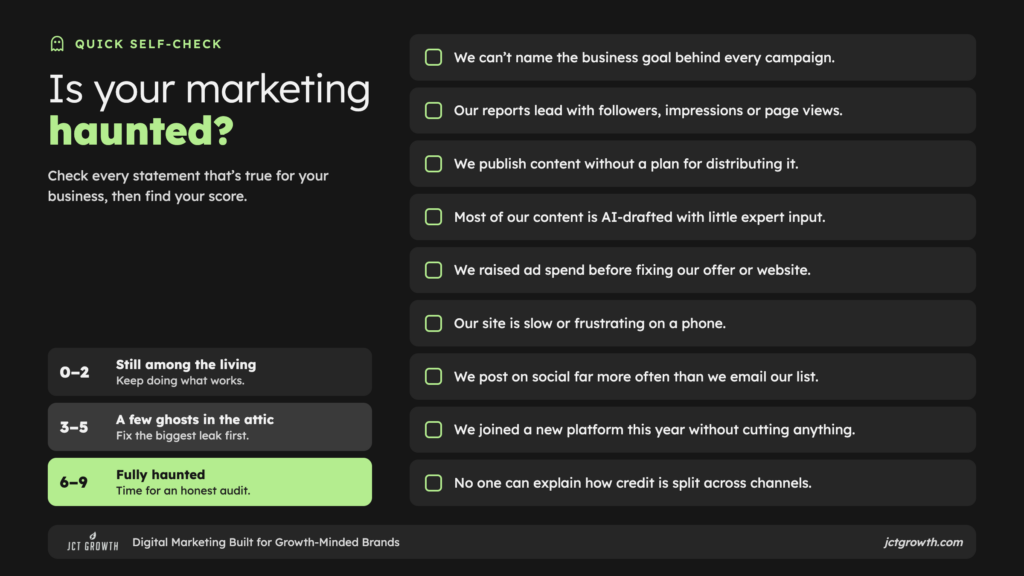
Vanity metrics look impressive in reports but don’t connect to business results. Follower counts, page views, and impressions can all go up while revenue stays flat.
| Vanity Metric | Why It's Misleading | Meaningful Alternative |
|---|---|---|
| Follower count | Followers don't equal customers | Qualified leads from social |
| Page views | Views without engagement waste efforts | Conversion rate by traffic source |
| Impressions | Seeing an ad doesn't mean caring about it | Cost per aquisition |
| Likes and shares | Engagement doesn't pay invoices | Revenue attributed to channel |
The metrics that matter are the ones tied to leads, conversions, and revenue. Everything else is decoration.
Paid ads can't rescue a weak product
Paid marketing amplifies whatever already exists. Ads accelerate growth for brands with strong products, websites that convert, and messaging that resonates with customers. If any of those elements are weak, ads just accelerate the problem.
Running paid campaigns before fixing foundational issues is like turning up the volume on a broken speaker. You’ll spend more money, but you won’t hear anything clearer.
SEO isn't dead, but bad SEO will bury you
Every few years, someone declares SEO dead. It never is. What does die are outdated tactics: keyword stuffing, buying spammy backlinks, ignoring technical issues, and treating search engines like they can be tricked.
Bad SEO can trigger penalties that take months to recover from. Meanwhile, competitors who invested in quality content and technical health continue to gain ground. The businesses that treat SEO as a long-term discipline rather than a quick fix tend to be the ones still visible when the dust settles.
Your website is scaring buyers away
A slow, confusing, or cluttered website drives potential customers away before they ever learn what you offer. Common issues include:
- Slow load speed: Visitors leave before the page finishes loading
- Cluttered design: Buyers can’t find what they’re looking for
- No clear call to action: Visitors don’t know what to do next
- Poor mobile experience: Mobile users bounce immediately
Most businesses are too close to their own websites to see the friction points that frustrate first-time visitors. A fresh set of eyes, whether from a colleague or an outside reviewer, often reveals problems that have been hiding in plain sight.
Email marketing still beats social media
Email consistently delivers one of the highest returns on investment of any marketing channel, yet it gets less attention than flashier platforms. The reason is simple: your email list is an owned audience. Social platforms control how many of your followers actually see your posts.
When a social algorithm changes, your reach can drop overnight. Your email list doesn’t work that way. Email marketing campaigns drive direct conversions while social media often serves awareness. Both have a role, but email deserves more credit than it typically receives.
Chasing trends costs more than it earns
Every new platform or tactic creates pressure to jump in before you miss the wave. TikTok. Threads. YouTube Shorts. The latest AI tool. The fear of missing out is real, but so is the cost of scattered efforts.
Opportunity cost is the hidden expense of chasing trends. Time and budget spent experimenting with unproven channels is time and budget not spent on what’s already working. Focused, consistent execution almost always outperforms frantic pivoting.
Attribution is broken and reports often lie
Marketing attribution tries to answer a simple question: which channels and touchpoints deserve credit for a conversion? In practice, the answer is rarely simple. Buyers interact with multiple channels over days or weeks before making a decision, and most attribution models oversimplify this journey.
Reports can show what looks good rather than what’s true. A channel might get credit for conversions it didn’t actually influence, while another channel does the heavy lifting without recognition. Honest reporting acknowledges attribution limitations instead of pretending the numbers tell the whole story.
Halloween marketing campaigns work because fear sells
Okay, but what does this all have to do with Halloween (or other holidays)?
The psychology of fear means Halloween marketing campaigns often outperform expectations. Fear captures attention and creates urgency. It motivates action. Limited-time offers, countdown timers, and scarcity messaging all tap into the same primal response that makes haunted houses effective.
The psychology of fear behind successful Halloween campaigns
Fear triggers a fight-or-flight response that demands attention. Marketers use urgency through deadlines, limited inventory, or exclusive access. FOMO, the fear of missing out, is essentially loss aversion dressed in a costume.
When brands lean into Halloween themes, they’re given permission to use fear-based tactics more overtly than they might during the rest of the year. The holiday’s natural association with fear allows brands to create urgency without actually scaring away their audiences.
Think about candy brands, who almost exclusively market during the Halloween and Christmas seasons. Reese’s and M&M’s ads are “spooky szn” staples.
What Halloween influencer marketing reveals about buyer behavior
Paid ads and themed organic posts aren’t the only way to reach your customers. Halloween influencer marketing campaigns often outperform because they tap into shared cultural moments. People are already primed to engage with seasonal content, and influencers who participate authentically benefit from that collective enthusiasm.
Here’s the thing: The emotional triggers that work during Halloween (including urgency, exclusivity, and storytelling) work year-round. Seasonal campaigns just make those triggers more visible.
The scariest marketing mistake is doing nothing
Waiting for perfect conditions, more budget, or complete certainty often means competitors pull ahead while you stand still. Imperfect action beats perfect planning.
Inaction feels safe, but it carries its own risk. Markets shift, competitors improve, and opportunities close. The cost of doing nothing is often higher than the cost of making a mistake you can learn from.
Turn marketing fears into real growth
Awareness is the first step toward fixing any of the issues covered here. Most businesses deal with at least a few of them, and addressing even one or two can meaningfully improve results.
If you’re ready to take an honest look at what’s working and what isn’t, contact JCT Growth for tailored marketing solutions.
Frequently asked questions
A significant portion of most marketing budgets goes to channels that aren't properly tracked or measured, which means businesses often can't tell whether that spending is working or wasted.
Look for transparent reporting, clear explanations of what's working and what isn't, and a willingness to discuss failures alongside successes. Agencies that only share good news are usually hiding something.
Planning typically begins two to three months ahead to allow time for creative development, influencer partnerships, and promotional scheduling. Starting a few weeks before Halloween usually means rushing and missing opportunities.
Even if you’re not doing it this year, you can start thinking about the future.
Seasonal themes can humanize B2B brands when done with restraint and relevance. A playful Halloween email or social post can stand out in a feed full of corporate content, as long as it still connects to your audience's interests.